

Rotten Tomatoes has it at 74%. Certified Fresh. The first time in the live-action history of the franchise. A whole generation of fans assumed this day would never come, and yet here we are — Simon McQuoid has finally made a Mortal Kombat movie that the critics didn’t bury.
I’d argue that 74% is the most damning number the franchise has ever received.
Credit Where It’s Due
Let’s start fair. Mortal Kombat II fixes the two biggest complaints about the 2021 reboot. There is finally an actual tournament — not a half-hearted gesture toward one in the third act. Cole Young, the original character invented for the first film who absorbed too much of its runtime, gets pushed to the side where he belongs. Karl Urban as Johnny Cage is, by every account, the franchise’s most charismatic live-action presence to date. The fight choreography lands. The fatalities, when they come, are filmed with the kind of physical clarity action cinema has been losing for fifteen years. Every reviewer who saw it in a packed theater reports the same thing: the audience cheered.

So the film delivers exactly what it sets out to deliver. The problem is what it sets out to deliver.
The Story Is a Chassis with Wheels Bolted On
The opening promises something better. We drop into the realm of Edenia, where Shao Kahn (Martyn Ford) cuts down King Jerrod and walks off with the young Kitana to raise as his own. For a few minutes the film reaches for tragedy, weight, the operatic register the Mortal Kombat lore actually contains. Then it abandons it.
Here’s the spine. Earthrealm has lost the Mortal Kombat tournament nine times in a row. One more loss and Outworld walks in and finishes off all eight billion of us. Raiden (Tadanobu Asano) recruits Johnny Cage, a washed-up action star, who resists for exactly long enough to satisfy a screenwriting checklist before agreeing. Sonya Blade hits him with the obligatory line — you could’ve been one of the best — and the character arc is closed. Thirty minutes in, every emotional beat has been telegraphed, signed, and dated.

In the background, Shao Kahn is hunting a magical amulet that’ll turn him into a god (yes, another MacGuffin amulet, in 2026). Quan Chi (Damon Herriman) reanimates corpses. Shang Tsung schemes. Kitana works out that her adoptive father killed her real family, in what ought to be the emotional core of the film and which several critics, including Roger Ebert’s, have flagged as feeling like a footnote. Jade (Tati Gabrielle), positioned early as Kitana’s soul-sister, just dissolves into the rest of the cast somewhere around act two and never really returns. The climax stages three fights at once, then sets up the third movie, which is already greenlit. The franchise machine works. The film, as a film, runs on fumes.
The Comparison Problem
Here is the test that breaks Mortal Kombat II. We are not in 2005 anymore. We are in the era of The Last of Us, Fallout, Arcane. Three video-game adaptations that took their source material seriously enough to build characters, themes, and consequences alongside the spectacle — and were rewarded for it commercially and critically. Arcane in particular was a fighting-character ensemble piece, exactly the format Mortal Kombat should be plundering. It treated its cast as people with histories and contradictions, not as moves on a select screen.

Mortal Kombat II, by contrast, treats its cast as moves on a select screen. The film knows the audience came to see signature attacks, so it serves them. What it does not do is convince anyone that there is a person inside the costume executing them. The bar in 2026 is no longer “is this a competent action movie.” The bar is “have you matched what Arcane did in animation four years ago.” On that bar, Mortal Kombat II doesn’t reach.
Karl Urban Deserved a Better Script
After The Boys, where Urban proved he could be charismatic, absurd, and human in the same scene, here he is in a film whose chief demand is that he toss off one-liners about Squid Game and Big Trouble in Little China between gore showers. Critics keep saying he steals the show. Of course he does. In a film where the screenplay (Jeremy Slater, who also wrote Godzilla x Kong: The New Empire — not exactly a recommendation) flattens every character to a baseline, the show belongs to whoever happens to have a character at all.

This is Hollywood’s current operation. Hire a real actor, drop them into a cartoon, and watch the critics get misty-eyed because someone on screen is making an effort.
What 74% Actually Confesses
So when a film has, in the words of the very critics scoring it Fresh, no story (Variety), shaky character work (ScreenRant gave it a 4 out of 10), uneven pacing (Game Informer), and supporting characters who vanish into the chaos (Roger Ebert’s reviewer), and the score still lands at 74% — the score isn’t telling us the film is good. The score is telling us what critics are willing to forgive when the fights work and the fan service hits.
That’s the confession buried inside the percentage: if you’re a fan, you’ll love it. Translation: if you’re not, you have no business being in the room. A wide-release theatrical movie shouldn’t need that translation. The Last of Us didn’t. Fallout didn’t. They built rooms that anyone could walk into.
The 1995 original, also covered in rotten tomatoes when it came out, at least knew what it was. A 90s, Cannon-grade B-movie with neon lights and Christopher Lambert’s cool detachment. It didn’t pretend to be art. McQuoid’s version sits in the awkward middle: not stupid enough to be fun, not ambitious enough to be a real movie. Just enough blood to distract you from the fact that there’s nothing at stake — only soundstages, painted backdrops, and a pre-mapped trilogy roadmap.
Verdict
If you’re a fan, you’ll have a great time. The fights deliver, the fatalities land, the in-jokes hit. Friday’s screening will be the most fun you’ve had at a multiplex in months — and the most forgettable.
If you think a video-game adaptation in 2026 should be more than a two-hour cosplay convention with arterial spray, the bar has been set elsewhere, by Arcane and The Last of Us and Fallout. Mortal Kombat II isn’t trying to clear that bar. It’s trying to clear Annihilation from 1997. And by clearing it, it’s accidentally told us where the franchise’s ambition actually lives.
Flawless Victory? Try Test Your Might.
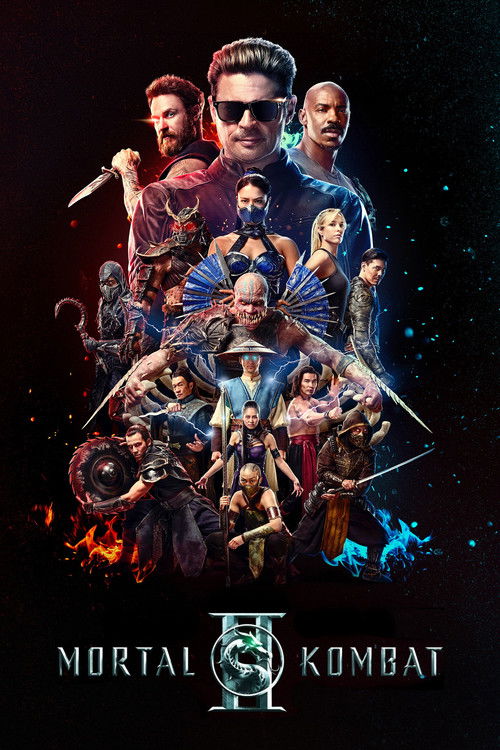
Data sources: FilmDB.co.uk and TMDb. Availability of information may vary, and accuracy is not guaranteed.
ActionFantasyAdventure116 min