

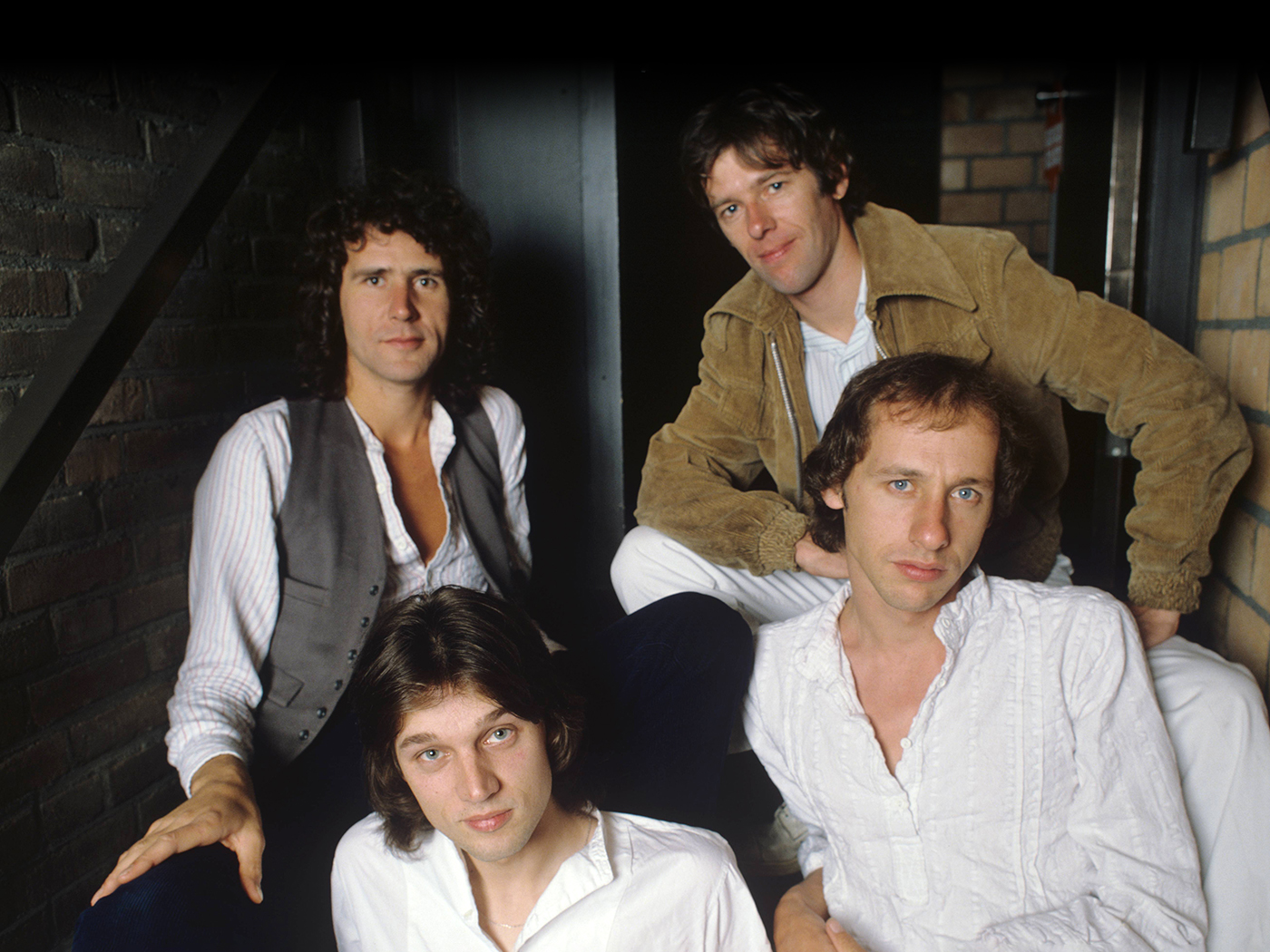
IT’S hard to believe now, but when they first formed in 1977, Dire Straits struggled to get gigs because their brand of liquid blues-rock was considered old hat by the new punk orthodoxy. Within eight years, the tables had turned spectacularly. Not only were Dire Straits the biggest band in the world, they were harbingers of a shiny new digital age, with Brothers In Arms becoming the first album to sell a million copies on CD.
“As a 14-year-old, you dream of playing the guitar in some form or other with other people,” says bassist John Illsey – along with frontman Mark Knopfler, the only ever-present Strait. “But having success, you never really thought about it. So we had to deal with a lot of things quite quickly. I think Mark and I made a pretty good team. We understood a little bit more about life because we both worked in a normal job for a few years.”
Ultimately superstardom didn’t really suit this band of modest musos, and they’ve been pursuing more personal projects since calling time on Dire Straits after just six studio albums. “A lot of people say, ‘Why don’t you get back together again?’ but I’m very happy with it stopping in 1993,” Illsley insists. “We did it exactly the way we wanted, and we did it pretty well. I got to play all over the world with some great people, and Mark and I’s friendship survives to this day, which for me is one of the most important things.”
“It’s lovely that people look back on the band with fondness and can still be inspired by it,” adds Guy Fletcher, keyboardist from 1984 onwards. “Songs like ‘Brothers In Arms’ play a big part in people’s lives. When you hear stories of people who have lost loved ones and the music gives them support, you feel a particular kind of warmth that you’ve been a part of that.”
DIRE STRAITS
Vertigo, 1978
The assured debut is an instant smash, thanks largely to the irresistible “Sultans Of Swing”, a Top 10 hit on both sides of the Atlantic
JOHN ILLSLEY: I was sharing a rather grotty council flat with David [Knopfler] in Deptford. Early one morning, I found Mark asleep on the floor in the sitting room. We started chatting, and I immediately thought to myself, ‘I’m going to know this chap for quite a long time.’ When we started playing together, I noticed there was a certain style about his playing which was pretty unusual – this rock’n’roll, bluesy picking-type thing, with no plectrum. Mark had played with [drummer] Pick Withers in a band called Brewer’s Droop, and as soon as he joined the band, it just felt right.
We eventually signed with Phonogram, and they had an interest in Basing Street Studios just off Portobello Road. This is a time when Portobello was pretty rough, you had to walk around in twos. We literally set up in the studio and played the songs that we’d got. Working with Muff Winwood was a great pleasure. So we made the album very quickly, and suddenly people started to take notice of us. I remember I got a phonecall in the flat. It was the record company, telling us we’d sold 25,000 copies of the album in Holland!
COMMUNIQUÉ
Vertigo, 1979
Moody, understated second, recorded at Compass Point and mixed at Muscle Shoals
ILLSLEY: We were with Warners in America, and Jerry Wexler wanted to do another album with us almost straight away. We were going, ‘Well, hang on…’ But when Jerry Wexler wants to produce your next album, you’ve got to be careful you don’t say no. And so suddenly we found ourselves in the Bahamas. We still lived in the council flat in Deptford, so we went from there to this mansion on the beach. Thankfully Mark was busy writing, and we were putting new material into the live gigs, but I think we felt a little bit under pressure.
We’d hired some equipment from Miami, and it didn’t turn up. I had to borrow an old, beaten-up bass amp from the local reggae band, and we found a Fender Twin from somewhere. Mark and David did pretty much all the album on one amplifier. We were just about to leave, and somebody said, ‘Why didn’t you use the equipment that’s here for you?’ They’d stuck it around a corner, and nobody told us. But by this time we’d done quite a bit of touring, we were quite sharp, and we played together pretty well in the studio. And we just picked up the vibe of the island. We used to drink a bit of rum and coke in the evenings and indulge in some local, exotic substances occasionally, so maybe that mellowed it all out.
MAKING MOVIES
Vertigo, 1980
Undeterred by David Knopfler’s sudden departure midway through the sessions, Dire Straits morph gloriously into Britain’s own answer to the E Street Band
ILLSLEY: I think one has to understand that by this time, there was an enormous amount of expectation and stress on the band. There are some people that can handle that stress. I’m quite good at that, Mark was good at it, and Pick was just a seasoned player. I think David possibly struggled a little bit with it. He didn’t feel that we were doing what we were supposed to be doing as a band, and there was a bit of friction. It was difficult for everybody, but it needed to be dealt with. And so David left. That was very sad, because he was a mate and we’d done a lot together. Suddenly the band was changing very quickly. But we understood we had some good material here, and we wanted to do the best we could with it.
Mark was writing some wonderful things. I remember him coming around to my place with his 1928 National steel guitar, and he started playing “Romeo And Juliet”, with this unusual tuning. I just said, ‘Mate, that’s an absolute cracker.’ I mean, there’s no doubt about it – it’s certainly stood the test of time very happily. I’m trying to think when he actually had time to write, because we were working all the time, but he did. We’d work up new songs in soundchecks, so by the time we got to the Power Station in New York, we had all the songs we wanted to do.
Mark wanted to get a keyboard player in because he thought, quite rightly, that this was going to enhance the band and make it happen on a different level. [Producer] Jimmy Iovine said, ‘Well, I can get you Roy Bittan from the E Street band, he’s free at the moment.’ So there we are with Bruce Springsteen’s keyboard player, and we were completely enthralled by his contribution. He started playing, and suddenly the whole music swelled in front of your eyes, with the keyboards and the Hammond organ. It was just fabulous.
LOVE OVER GOLD
Vertigo, 1982
With Knopfler now confident enough to self-produce, the band stretch out on ambitious multi-part epics “Telegraph Road” and “Private Investigations”
ILLSLEY: Most of that stuff was rehearsed on the road while we were doing a tour for the Making Movies album. [Keyboardist] Alan Clark had joined us by this time. He was a fabulous musician, and he and Mark traded off all sorts of ideas during rehearsals and soundchecks. You can imagine “Telegraph Road” being worked out piece by piece, this massive jigsaw puzzle which lasted for 15 minutes.
It’s a very unusual album. The record company were pretty desperate. They said, ‘My God, there’s no single on this record. What are we going to do?’ And we said, ‘You’re going to put it out the way it is.’ When you’ve had three successful records, you have a bit more sway. Who would have guessed that “Private Investigations” [a No 2 hit in the UK] would be climbing to the top of the charts?
I listened to it the other day, and I think it still hangs together pretty damn well. Mark’s writing was developing all the time, he was full of surprises. Suddenly something like “Industrial Disease” pops out of the bag, and “It Never Rains” – fabulous stuff. Really meaty playing, proper rock. Not heavy metal, but pretty heavy stuff.
EXTENDEDANCEPLAY EP
Vertigo, 1983
After the extravagance of Love Over Gold, a quick blast of old-fashioned boogie-woogie fun
ILLSLEY: Soon after we’d finished recording Love Over Gold, Pick Withers announced that he wanted to leave the band. For a drummer, these big tours are very hard work. He probably thought, ‘I’m not sure I can go on the road like this again.’ So we were in a situation where we were looking for a drummer, and Terry Williams [ex-Rockpile] appeared out of the mist, highly recommended by a lot of people. Mark had these other songs, I can’t really remember where they all came from. So we said, ‘Well, let’s get Terry in the studio and record some songs with him.’ It was also an opportunity to lighten up a bit, because Love Over Gold was quite an intense record. “Twisting By The Pool” felt so fresh and different from everything else we’d ever done, and it turned out to be a bloody big hit. When we played it in stadiums, everybody went bonkers.
ALCHEMY
Vertigo, 1984
A quintessential 1980s live album, with Knopfler’s quicksilver licks on full display. Concludes with his impossibly rousing theme from Local Hero
ILLSLEY: The band had so much power, dare I say it, at that particular point in time. I was talking to somebody the other day who told me that his favourite Dire Straits album is Alchemy. He said, ‘That was the band at its peak’, and I think he’s probably right. It was a bit of an experiment. We recorded three nights at the Hammersmith Odeon, and I think the middle night was the one that just had it. We didn’t use anything else. It was Mark’s idea to try and blend one song into another, rather than stop and clap, clap, clap – just get this whole feel of the evening, flowing one song into the next. I don’t think we edited hardly at all; we didn’t need to. It felt like this was a proper live album.
Last time I was in Paxos, I went down to the local cocktail bar on the harbour and suddenly, “Once Upon A Time In The West” comes blasting out of the speakers. I’m thinking, ‘My god, did we really play like that?’ It was so powerful.
BROTHERS IN ARMS
Vertigo, 1985
I want my MTV! Slick videos and even slicker digital production help create the first million-seller in the shiny new CD format
GUY FLETCHER: Mark needed somebody to work on the soundtracks to Cal and Comfort And Joy. And so I literally turned up at his Holland Park mews house with a keyboard under my arm. It soon became apparent that we were speaking the same language. He pointed to this thing called the Synclavier – which is a very complex, very expensive digital synthesiser that he just bought – and said, “Can you operate that?” It didn’t take long for me to figure it out, and pretty soon we had this working relationship where I could realise the stream of ideas that he always has. Before I knew it, I was involved in preparing for Brothers In Arms.
ILLSLEY: We moved to Phil Mazanera’s studio down in Surrey to do a bit more work on the songs. We now had two keyboard players: Alan Clark, who was a fabulous piano player, and Guy Fletcher, who was very technical. So there were lots more possibilities. I could see everything moving along into areas which we’d never looked at before.
This is where the coincidences of life happened. Mark was very keen to embrace the whole digital experience, so we ended up buying this Sony digital recording machine – which was still tape, but it was digital tape. So we carted this machine all the way to [AIR Studios in] Montserrat and recorded the album on it over a period of about two or three months. And as a consequence of that, we were embracing this whole digital element to the music and how clear it was, and how you weren’t limited by the amount of tracks you could put on this tape. At the same time, Phillips was developing this new way of listening to music called a compact disc. And so we became the flagship bearer of this new technology.
There were some happy accidents in the music, too. Somebody knocked over a microphone, it was lying on the ground, and Mark started playing. [Co-producer] Neil Dorfsman stood up and said, “Don’t move anything – that’s the sound.” So the rather extraordinary guitar sound on “Money For Nothing” was produced by somebody knocking something over.
FLETCHER: Neil Dorfsman did a remarkable job in retaining the warmth of the sound, because digital was so different-sounding when you compared it to analogue. At the time, I think it wowed a lot of people. It was a really remarkable period in any band’s history, so to be a part of that was pretty extraordinary.
ON EVERY STREET
Vertigo, 1991
With the band left reeling by Brothers In Arms’ staggering success, its eventual follow-up eschews the anthems for deep, bluesy workouts
ILLSLEY: After we’d done the Brothers tour, which was pretty big, I thought that that was probably enough for the band. I personally couldn’t see what you would do after Brothers In Arms. We did the Mandela birthday concert, where Eric Clapton played rhythm guitar with us, and we did a few Princes Trust gigs, which was lovely. But I thought we probably won’t do [any more recording]. Then Mark and I had lunch one day, and towards the end of the lunch, he said, ‘Do you fancy making another record? I’ve got some songs which I think the band should do.’ I said, ‘Fabulous, let’s do it!’ We recorded it in AIR Studios in Oxford Street.
FLETCHER: It was exciting. Different band, different set of songs, slightly different direction. So it was all new again. Mark’s fondness for folk and Americana, the whole country element, gave a slightly different tinge to it.
ILLSLEY: We took our time with it, so there was a lot of experimentation going on. Guy and Alan were trying all sorts of things. I’d go and walk down Oxford Street, come back again, and they’d still be trying different things out. So we ended up with some very interesting elements on that record. Jeff Porcaro was incredible to play with, so that was great. I think On Every Street is a bit underrated, actually. I think it’s a pretty damn good album. They say it had disappointing sales, but I don’t know what’s disappointing about 12 or 15 million albums. If you did that these days, you’d be very happy!
ON THE NIGHT
Vertigo, 1993
Another mammoth world tour finally breaks Dire Straits for good. But on stage, the chemistry still crackles
ILLSLEY: By the time this was recorded, the band was playing really well together. We had Paul Franklin on pedal steel, and Chris Whitten on drums, who had just finished with McCartney. He was amazing, actually. Every night was a pleasure. I stood in front of Paul Franklin for 248 shows, and listening to him play that pedal steel guitar was sheer heaven. Him and Mark trading off solos was just fabulous. I used to stand there thinking, ‘Does it get any better than this?’
FLETCHER: We were definitely riding a wave of success. But that tour was long – 14 months – and by the end of it, everybody had definitely had enough.
ILLSLEY: I think we all knew that that was probably going to be the final curtain. It was psychologically draining, as well as physically draining. Mark and I had several conversations about it, and I completely understood where he was coming from. I’d had enough as well. I thought, ‘Well, I’d quite like to go back to doing some painting’, which I enjoyed immensely, and still do to this day. So it was a happy ending, as far as I’m concerned.