

First published in Uncut Take 318 (November 2023 issue)…
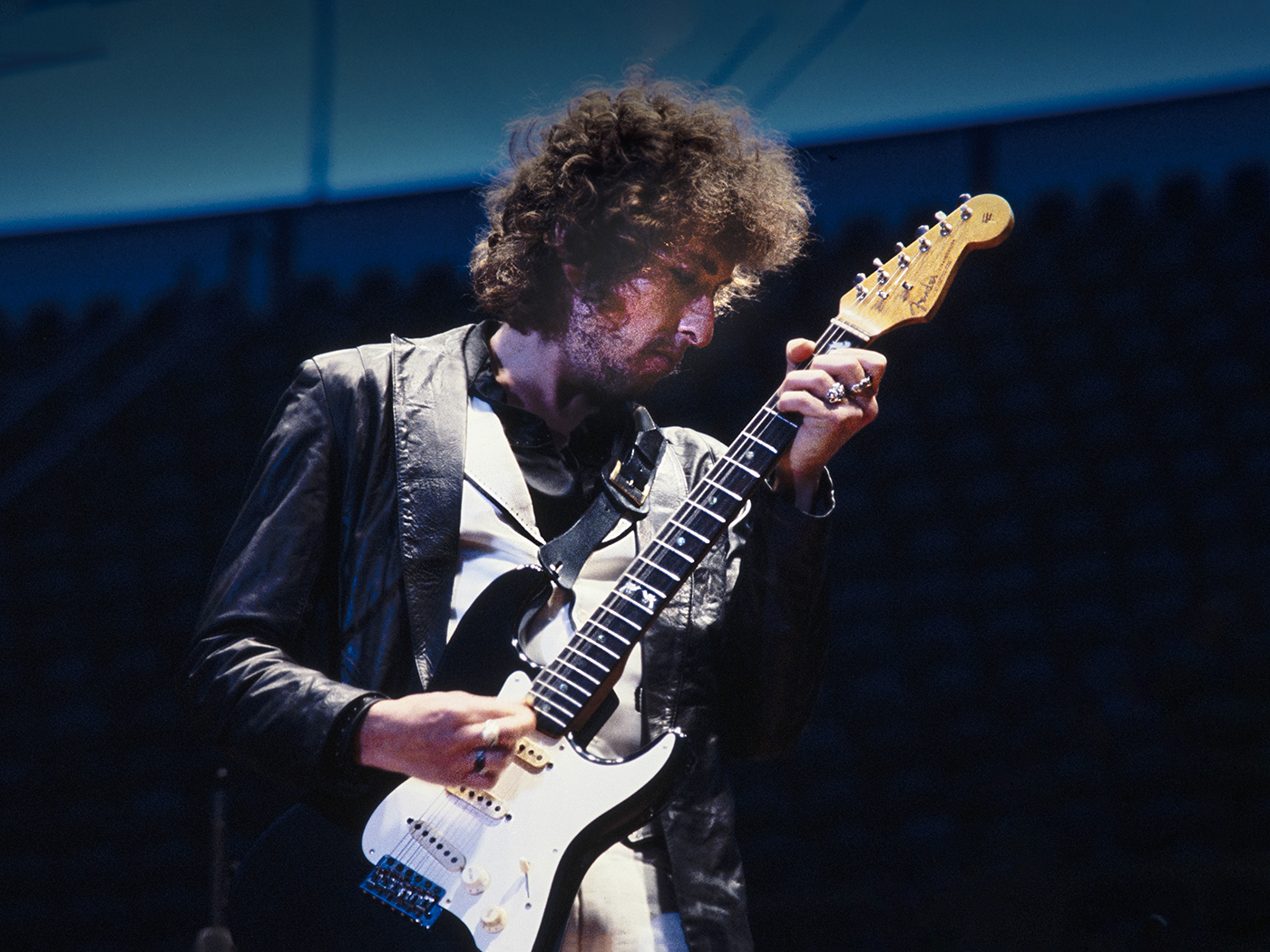
On February 20 1978, Bob Dylan stood on stage at Tokyo’s cavernous Budokan concert hall wearing a bespoke three-piece white silk suit, a blue muffler and a generous application of eyeliner. It was his first time playing Japan – the first night he’d toured anywhere outside North America since the epic of 1966, when he and the Hawks famously flew into an electric storm of controversy. And, once again, he was venturing out backed by a band unlike any he’d had before.
The year-long world tour that stretched ahead was his most ambitious and demanding, leading an 11-piece group through 114 concerts across three continents. It eventually played to some two million people – with an estimated quarter million of them at one gig alone.
It also became one of his most polarising tours. Fans cherished some shows as the greatest they’d ever seen. Critics, particularly in America, had the knives out. Contrasting Dylan’s new style with the rootsy romance of the preceding Rolling Thunder Revue, the undertaking was castigated as soulless showbiz cabaret, a cash-grab that, following Dylan’s recent divorce, was swiftly labelled ‘The Alimony Tour’. The band he’d assembled was disparaged as his attempt to ape everyone from Elvis Presley to Neil Diamond and Bruce Springsteen. The reaction was encapsulated by the headline to Rolling Stone’s review of Street-Legal, the album Dylan released mid-tour: “Never So Utterly Fake”.
“That period was unfairly condemned,” says Rob Stoner, who helped Dylan build the 1978 band. “Sure, it was radically different to Rolling Thunder: matching outfits, a slick presentation, staging. They said we were trying to copy Springsteen because we had a sax player. Sorry, what the fuck? That sax player was Steve Douglas, man. The guy who played on all opening night, Dylan had an immediate problem. Back in 1966, he’d faced down boos and catcalls. Now he faced near-silence.
The opener, a kicking version of Curtis Jones’s 1937 blues “Lonesome Bedroom”, might have been an obscure choice, but Dylan had followed it with a song anyone coming to see him would surely know, “Mr Tambourine Man”. Still nothing. Aside from a polite ripple of applause, the 14,000-strong audience sat quiet. Dylan glanced over his left shoulder, where Stoner, similarly swathed in silk, stood wielding bass.
“Bob turned around,” says Stoner. “He said: ‘Wow. This crowd’s dead, man. They just don’t dig me.’” How did we get here?
THEY used to make guns there, and for the moment it was exactly what Bob Dylan needed. For years, 2219 Main Street in Santa Monica played home to Clerke Technicorp, manufacturers of the Clerke First revolver, considered by many the worst handgun ever produced in America. Late in 1977, however, the building fell empty. Music Touring Company, an anonymous entity Dylan had created to oversee his interests, quietly took the lease.
Occupying an inconspicuous corner two shabby blocks from the beach, a 30-minute drive from his Malibu home, this nondescript industrial unit became Dylan’s base of operations for the next five years, his own Hole-In-The-Wall. Downstairs, offices taking care of business. The real work would go on upstairs, in the old workshop recast as rehearsal room. Reflecting its rudimentary nature, Dylan called it “Rundown Studios”. Settling in, he began preparing his next move.
“It’s a converted gun factory, and you can still see, like, gun parts lying around,” says Stoner of his first sight of Rundown, after Dylan called him out there in the last week of 1977. “Not set up as a rehearsal hall at all. We’re not talking professional and slick. A few amps, a crappy piano. Budget place.”
“They’d made pretty much zero accommodation to change this from a place for gun manufacture,” adds Mansfield, who soon joined Stoner. “No acoustic treatment. Plenty of room, but not exactly optimised for sound.”
Both stalwarts of the Rolling Thunder Revue, the travelling circus Dylan led across the States in the Bicentennial winter of 1975, neither Stoner nor Mansfield had heard from him for over a year-and-a-half, after Thunder’s second leg fizzled out in spring 1976. But aside from his brief spot at The Band’s Last Waltz, and news stories across 1977 concerning his divorce and custody battle with his ex-wife, Sara, few had.
Dylan had spent much of the intervening period out of sight, holed up in a film suite, working through the mountain of footage he’d shot during the Rolling Thunder tour. Editing lasted 18 months, an unheard-of amount of time for a man with a reputation for preferring to work fast, who recorded his most famous albums in days.
“Bob turned around AND said: ‘Wow. This crowd’s dead, man. They just don’t dig me.’”
As 1977 ended, Dylan was finally done shaping Renaldo & Clara, all four hours of it. Including the film, Rolling Thunder had consumed over two years of his life. Casting himself opposite Sara in the title roles, the film the assiduously private artist was about to make public seemed on one level his portrait of their relationship – albeit a fractured, coded, Cubist-Surrealist portrait. It was not surprising that he was ready to move on.
Certainly, the plan for Tour 78 suggested as much. Rolling Thunder had been dyed-in-the-wool Americana. Now Dylan set himself to shake the USA from his heels, scheduling the first 11 shows in Japan starting February, followed by dates through New Zealand and Australia the following month. This was first chance anyone outside the USA and Canada would have to see him since his one-off appearance on the Isle Of Wight in 1969. For this, Dylan wanted a markedly different band from the raggedy Revue, even though key players – alongside Stoner and Mansfield, drummer Howie Wyeth and guitarist Steven Soles gathered at Rundown – were recalled as its core.
“Bob didn’t want another Rolling Thunder,” says Stoner, Dylan’s bandleader for that adventure, who was now handed responsibility for building the new ensemble. “But he didn’t want another rock’n’roll jukebox re-enactment of greatest hits, like the Stones. Bob wanted something radically different. We started talking about rearranging songs: ‘Let’s do this as a chacha; this as a waltz; this one real quiet.’ Turn everything on its head. He was thinking about a large band, tonal qualities he hadn’t had. Like saxophone. That’s why I hired Steve Douglas, who doubled on flute. I originally brought a pianist, Walter Davis Jr, a jazz cat who’d played with Bird.
“But Davis got sick of waiting and split, because Bob doesn’t show up, for days. He’s renovating his new house at Point Dume, he’s getting Renaldo… ready for release, doing interviews, there’s the divorce… Too much extracurricular shit. He told me: ‘You rehearse the band, find musicians.’ I started taping everything, so Bob could hear it. He’d show up after everybody had left, and we’d strategise over tunes.”
As the new year got rolling, Stoner put word out over LA’s music grapevine: Dylan was building a band. Soon a parade of players was passing through Rundown. With opening night in Tokyo set for February 20, the clock was ticking. Dylan’s attendance grew more regular, to the point he started sleeping over in the office.
“The entire tour rehearsal was an extended audition for the rest of the band,” says Mansfield. “The way Bob works is: he starts playing and you play with him and hang on. A lot of people got replaced.” Among the first signed up was guitarist Billy Cross.
“I arrived and Arthur Rosato, Bob’s main technical person, pulled me aside,” says Cross. “He said, ‘Look. All the guitarists who’ve auditioned have been terrified of Bob. It’s too much. Just play loud. Step forward.’ So, I played pretty loud. We took a break. Bob walked over and said, ‘Hey, got any smokes?’ – I remember thinking, this is Mickey Spillane talk. I gave him a Marlboro, he said, ‘Whatcha doing the next year?’ I said, ‘Well, I hope I’m playing with you.’ He said, ‘You got the job.’”
To replace the departed Davis, Stoner called another pianist with a jazz background he’d encountered in New York, who happened to live nearby in Santa Monica. “Alan Pasqua,” smiles Stoner. “This cat was even better.”
Pasqua recalls watching a band being whittled into shape. “When I got to Rundown, it was clearly an audition, and a cacophony, because there were multiple people playing the same instrument. Several drummers, three keyboard players. We played en masse, then individually. Next day, we did it again. Then I got called back and there were only two keyboard players. I thought: ‘Ah, I understand what’s going on.’ So now I enter Competition Mode. One day, I was the only keyboard player left.”
Finding a drummer became a particular problem. With Japan looming, original choice Howie Wyeth ruled himself out.
“Wyeth had a heroin problem,” says Stoner. “This tour’s going somewhere he can’t get drugs. He tried to kick, but was getting real dope sick. He finally just headed back to New York. Bob begged Howie to come back, offered to get him in a clinic. But Wyeth turned it down.”
They finally found the ideal replacement in Denny Seiwell, late of Paul McCartney’s Wings. Or so it seemed.
“Just days before we had to leave, we got a telegram from the Japanese embassy,” says Stoner. “They’d refused Denny’s visa, because he’d been busted for pot with McCartney in ’72.”
At the last minute, King Crimson’s Ian Wallace was parachuted in, completing a band that also included Motown-schooled percussionist Bobbye Hall and three female backing vocalists, Helena Springs, Jo Ann Harris and Debbi Dye. Such singers were perhaps the most unprecedented addition, but would become vital to Dylan’s live sound in the years ahead.
The desire to change things up wasn’t necessarily purely artistic. “Bob lost so much money doing Rolling Thunder,” says Stoner. “Renaldo… cost a bunch, the divorce was expensive. I think after he finished Renaldo, he looked at his bank balance, and realised: ‘…Wow.’ He wanted to make some money, man. So he asked himself: ‘Who are the biggest acts in the world? And who runs their show?” So he hooked up with Jerry Weintraub.”
Dylan had done without a personal manager since parting with Albert Grossman in 1970, but in 1977 he signed with Weintraub’s company, Management III. For fans who held to the idea of Dylan as poet of the counterculture, it might have seemed a perplexing choice.
One of the biggest players in the business, Weintraub had come into his own as the 1970s dawned, when he persuaded first Elvis and then Frank Sinatra to undertake unprecedented tours of huge arenas, transforming their careers and pioneering the stadium show era. His other clients included Neil Diamond, whose Las Vegas act Dylan caught in summer 1977.
As Stoner recalls, “Weintraub told Bob, ‘If you want to take it to the bank, you gotta do one of these slick, money-making tours. Just go out for a year, bust your ass, then you can go back to doing whatever you want.’
“That’s where the stage uniforms came from,” says Stoner. “Weintraub thought a slick presentation was commensurate with a commercial act. But Bob also said: ‘I’m sick of everybody going on in just their street clothes.”
To create stage costumes, Weintraub suggested Bill Whitten, the LA designer who’d put Diamond into a jumpsuit, and previously fashioned audacious attire for everyone from Elton John to Iggy and the Stooges. For Dylan and band, Whitten—whose most famous creation came in 1982, when he gave Michael Jackson his white glove—conjured an unabashed symphony in black-and-white silk, satin and velvet.
“Ah.” Billy Cross shakes his head. “Some weird stuff. But I got a black velvet suit out of it.”
“Those clothes. Suddenly there’s a tailor at rehearsals. Band uniforms. Quite the change from Rolling Thunder.”
“Hoy,” Mansfield sighs. “Those clothes. Suddenly there’s a tailor at rehearsals. Band uniforms. Quite the change from Rolling Thunder.”
“I thought they were pretty cool-looking suits,” says Stoner.
The show was further defined by a message from Japan. “Bob got this telegram from the Japanese promoter,” explains Stoner. “‘Gotta do the hits.’ The guy’d heard Bob wasn’t always doing those songs in Rolling Thunder and he was like: ‘I’m paying you, this is what I want.’ Bob didn’t like being told what to play. But we said OK: since this guy’s insisting on these songs, let’s do them as if they were new. So we changed up even more. That was the beginning of the thing Bob’s been doing ever since live, radically reinventing the tunes – partly to keep himself interested.”
With sax, congas, flute, fiddle and singers at his disposal, Dylan set about customising his catalogue for the road: an instrumental “Hard Rain” as walk-on fanfare; “Knockin’ On Heaven’s Door” in reggae garb; “All I Really Want To Do” as a sprightly pop cousin to “The 59th Street Bridge Song (Feelin’ Groovy)”; an extraordinary “It’s All Right Ma (I’m Only Bleeding)” that suggested Led Zeppelin in a throwdown with a gospel incarnation of The Ronettes.
As January ended and rehearsals intensified, Renaldo & Clara was released in America – and torn apart, as the critical establishment seized on Dylan’s film as a colossal vanity project. The most savage critique came from The Village Voice, which sent seven reviewers to maul it in tandem. One piece began: “I wish Bob Dylan died.”
“I was very aware of the reviews,” Mansfield recalls. “It received such a unanimous drubbing. I wasn’t that surprised: I went to the LA premiere and saw how impenetrable Renaldo was. Not for the faint of heart, I don’t know how Bob felt, but Bob did read reviews. It couldn’t have been easy.” But Dylan was flying on to the next thing.
DYLAN’S first visit was a major cultural event in Japan, and the media build-up had been intense. The band got an inkling of the anticipation when they landed at Haneda Airport on February 17 to find 150 reporters on the runway.
“We got off the plane in Tokyo, man, we were mobbed,” says Stoner. “It was like The Beatles.”
“The press got out of hand,” Pasqua continues. “Security had to be brought in to do a pushback. It got frantic.”
The muted response that greeted them as the first show at Budokan began, then, was even more startling. As Pasqua recalls, “Everybody’s first thought was: ‘Uh… do they like this?’”
“I WAS VERY AWARE OF REVIEWS. IT RECEIVED SUCH A UNANIMOUS DRUBBING. BOB DID READ REVIEWS. IT COULDN’T HAVE BEEN EASY.”
“We were worried,” agrees Mansfield. “But then, at the end, there’s suddenly thunderous applause. We eventually realised Japanese audiences loved the show – but the protocol at that time was similar to classical concerts. If people started cheering, or stood, ushers would shine lights on them, make them sit down. It was strictly not acceptable, the same way it’s gauche to applaud between movements in a symphony. But it took some getting used to.”
There were three shows in Osaka, but Tokyo’s massive Budokan became their main Japanese haunt, with eight gigs. Unbeknown to the band until the last minute, two were scheduled to be recorded for a live album. Negotiations had been ongoing between Sony in Japan and Dylan’s camp for months, but Dylan didn’t greenlight recording until after he’d landed in Tokyo.
Originally intended only for Japan, but released internationally due to demand, the At Budokan album, recorded on February 26 and March 1 only the seventh and eighth shows of the year-long expedition – became Tour 78’s defining artefact.
“I felt some disappointment that Budokan was the live album,” says Mansfield. “I mean, rather than something from Europe, later in the year, when we were on fire. Across the year, musically, it just got better and better.”
Pasqua takes a different perspective: “I like early takes. I want that original energy. In Japan, we were still flying by the seat of our pants. Budokan stands up on that merit alone for me. There’s an urgency you’re not going to get if we’d been playing that stuff all year long.”
By the time the Budokan album appeared, Rob Stoner had long departed. He’d left after the tour’s opening leg in Japan, New Zealand and Australia, citing age-old musical differences. From his side, Stoner says he had a particular problem connecting with drummer Wallace: “Guy could not swing.” Still, he vividly recalls the response when the live album appeared in America.
“We were excoriated when …Budokan came out. People complained, ‘This doesn’t sound like Bob Dylan’ – well that’s the fucking point.”
DYLAN reconvened the band in Rundown in April, days after returning from the far side of the world. First point of business was a new bass player. Stoner’s replacement was an inspired choice: Jerry Scheff, veteran of Elvis’s band and The Doors’ LA Woman. Debbie Dye had also left, replaced by Carolyn Dennis, a gospel-raised singer who, when offered the job, asked who Bob Dylan was. Eight years later, she would marry him.
The newcomers were thrown in at the deep end. Weintraub was finalising the tour’s next leg, with a week in LA early June serving as preparation for the main event: Dylan’s return to Europe. There, he’d kick off with a week-long residency at London’s Earls Court beginning June 15. Only problem was, Dylan wanted to record a new album before hitting the road – and wanted it released in time for the London gigs, less than two months away.
Written at his farm in Minnesota the previous summer, Dylan had been carrying what became Street-Legal for a while. Stoner recalls Dylan playing him fragments of songs in Rundown around Christmas 1977. They’d snuck one, “Is Your Love In Vain”, among the hits at Budokan.
With time pressing, Dylan resolved to record at Rundown, against advice. Don De Vito, Desire’s nominal producer, returned, but most participants agree had minimal creative input.
“Don was more a record company liaison guy,” says Stoner, who’d observed De Vito while making Desire.
“Not necessarily a person of musical talent,” Cross puts it. “But someone who made sure people were happy and well-functioning.”
The primary concerns were technical. As Biff Dawes, the engineer eventually tasked with recording the album, recalls: “Arthur Rosato called me to Bob’s makeshift rehearsal room. My understanding was, Bob was going through some personal issues after his divorce and really wanted to record in this place. He wanted to know if it was possible. It was an older office space: an eight-foot ceiling, everybody was crowded in. This was a big band. He’d already had some prominent engineers in. They’d told him: ‘No way.’ But I thought, is it ideal? No. But it’s possible.”
An employee of Filmways/Heider, Dawes specialised in multi-track live location recording. He’d already helped capture Dylan live on Before The Flood—the album documenting Dylan and The Band’s monumental 1974 tour. Parking the Heider remote recording unit outside Rundown, running lines through the windows, he wired the gunshop for sound.
“This room was not meant for music,” Pasqua says. “Eventually, we put Bob into one of the bathrooms to sing: his isolation booth. It’s actually a pretty good-sounding record considering how it was done. Old-school. Basically live.”
“There were assistants placing microphones, cables, putting baffles between musicians, getting everything separated so it could be mixed,” David Mansfield remembers. “But Bob was ready to make music and got frustrated. At a certain point he just said: ‘Get all that stuff outta here – everybody pull round in a circle and let’s start playing.’ Engineers are scrambling around us to get mics into position, while Bob just launches into stuff.”
“Communication was really difficult, because I’m downstairs, outside, in a truck,” says Dawes. “No video monitors, I can’t see anything. Bob likes to be spontaneous and my team had to be ready to switch gears, switch instruments, change mics. I still remember the urgency: I’m on the edge of my seat, just wanting to make sure I get everything.”
Recording lasted five days. With most of the band hearing songs for the first time, Dawes caught music made on the hoof. Music that shone black and gold. Songs that saw the world as strange and dangerous, and love as a precarious shelter. Complex lyrics that extended the shifting perspectives of Blood On The Tracks and – densely shaded by tarot imagery and Biblical reference pushed Desire’s magical bent in eerie directions. The opening words of the first track, “Changing Of The Guards” hinted at autobiography: “Sixteen years…” the length of time since Dylan released his first LP.
On release, the album received decidedly mixed reviews. In the UK, the NME hailed a major work. Rolling Stone led the countercharge, with two writers slating it over successive weeks; Greil Marcus’s “Never So Utterly Fake” critique was almost paralysed with loathing.
Over the years, however, Street-Legal’s “shoe box” sound became its most criticised aspect. In 1999, Don De Vito remixed the album for reissue. Reflecting on the hurdles he faced, Dawes is philosophical: “Around the time he did the remix, Don told me if I hadn’t agreed to record it, those songs probably wouldn’t have been recorded. He really wasn’t sure what was going to happen with Bob if he couldn’t do it in his space. Don was just happy to get him on tape.”
More pressingly, Dylan had his album on the street the day he opened in London.
News of Dylan’s tour sparked a frenzy in the UK. With postal applications not made available, fans had to buy tickets for the London shows in person. Fifteen special offices were set up from Glasgow to Southampton. At one London site, the queue was 9,000-strong when the box office opened; some had camped outside for days. The 94,000 tickets disappeared in hours.
Arriving in town on June 12, Dylan spent his first nights acclimatising, ghosting through post-punk London’s clubs and cinemas. On June 15, against a carnival atmosphere, he made his long-awaited return to a British stage. “The Greatest Concert I Have Ever Seen” ran the headline to the Daily Mail’s review.
“That week at Earls Court was very much an event,” Mansfield remembers. “Backstage, George Harrison, Mick Jagger – they were all there. The excitement, you could cut it with a knife.”
After London, the tour rolled on to the Continent. “We had our own special train,” says Pasqua. “These great old carriages that would hook up with other locomotives to pull us where we needed to go.”
There were shows in the Netherlands, Sweden, a five-night stand in Paris. But things reached a pitch of intensity when Dylan played his first gigs in the then-West Germany. In Cold War Berlin, militants protested the new style with boos and a barrage of paint-soaked rags. For many, however, it was the concert in Nuremberg that was the year’s most memorable, playing to 80,000 in the Zeppelinfeld, former site of Hitler’s rallies.
“That week at Earls Court was very much an event. Backstage, George Harrison, Mick Jagger – they were all there. The excitement, you could cut it with a knife.”
Following discussions with Dylan, the German promoter erected a stage on the opposite side of the field from Hitler’s podium, still standing as part of the fascist arena architect Albert Speer had designed for mass Nazi gatherings in the 1930s.
“I was told we’d set up purposefully opposite it, so we could face that and play our music,” says Pasqua.
“We’re facing the big ‘A’ General Patton had painted,” says Mansfield, referring to the US Third Army symbol daubed over the lectern by GIs in 1945. “And we start playing ‘Masters Of War’. This moment was not lost on anybody.”
“This is an old one: it gives me great pleasure to sing it in this place,” Dylan hollered, leading off a garage version that melded the 1963 song to the “Louie Louie” riff.
“That was a pretty heavy-duty emotional situation for a lot of us,” says Billy Cross. “My background is Jewish, same with Steven Douglas, David Mansfield… Bob Dylan. It was heavy.”
If Nuremberg was the emotional peak, the final date, back in the UK, was the most logistically immense. Following the frenzy around Earls Court, British promoter Harvey Goldsmith swiftly negotiated an additional performance: a mini-festival on the flat field at Blackbushe Aerodrome south of London. Dubbed “The Picnic”, the lineup for the July 15 event included Eric Clapton, Joan Armatrading and the ascendant Graham Parker & The Rumour.
By the time Dylan took to the stage at twilight wearing a top hat borrowed from a hotel doorman, gate-crashers had swollen the audience to 250,000 – not merely the biggest crowd of his career, but the biggest ever gathered for a concert in the UK.
“I was told it was Dylan who wanted me on the bill,” says Graham Parker. “When we walked out, I couldn’t see anything beyond people. I’ve played some big festivals, but that crowd was astonishing. I met Dylan backstage. I asked him, ‘Are you playing “Love In Vain” tonight?’ His guitarist wandered by and Bob shouted, ‘Hey, can we play “Love In Vain”?’ When they started it, Dylan was in the wrong key. It didn’t seem it was too practised, so I like to think Bob remembered me asking. He did loads of Street-Legal, which I loved, sloppy and great. Just a fine, tight, band. Fantastic show. I mean, all that ‘Dylan’s Gone Vegas’ stuff – you expect the unexpected from Dylan. I think, by 1978, he had earned the right to do whatever the hell he wants, with any configuration of musicians.”
NINE weeks after Blackbushe, the band started on the road through America and Canada, facing their most gruelling schedule: 65 gigs in 62 cities between September 15 and December 16.
Following the rapturous response overseas, the mood around the tour grew harsher in America. They’d had a taste back in June, before hitting out for Europe, during the week-long warm-up at Los Angeles’s relatively intimate Universal Amphitheatre, when voices could be heard calling: “What is this, Las Vegas?” “Get rid of the chicks!” “Acoustic! Acoustic!”
By the time they returned in autumn, with blood in the water from the savaging given to Renaldo & Clara and Street-Legal, reviewers had adopted the “Vegas” cry en masse. Reviewing the New York show, Time magazine branded Dylan a “Bleecker Street parody of a Vegas lounge lizard”.
“Musically, the whole year was an upward progression,” says Mansfield. “We just got better. Bob seemed in a good mood. I mean, compared with when we’d worked before, he was much more playful on stage, talking to the audience, making jokes, hanging out with the band in the bar after shows – this was not the Rolling Thunder Bob Dylan, who had a black cloud over his head.
“But, fact is: we got a lot of negative press. That ‘Vegas’ tag was a very real thing. In the eyes of the music press, Rolling Thunder was cool. The 1978 tour was not.”
Late in the tour, a crew member who wasn’t wearing his safety harness fell to his death while taking down the system. “That put a big dent in my emotional state,” Cross remembers. “We were all tired from doing this for a year. I’m only speaking for myself, but after 65 shows in the US, there was an emotional fatigue. A melancholy.”
The end of the road was nigh. Dylan was about to take another path. One year later, while on stage with his gospel band playing a very different set of songs, he’d look back to the closing stages of the 1978 American tour and describe to the audience how he’d felt a similar fatigue, isolating one moment as the turning point.
During the November 1978 show in San Diego, Dylan said, he was feeling sick, when he noticed someone throw a silver cross on stage. Dylan put it in his pocket. Next night, in Arizona, he was feeling worse. “I said, ‘Well, I really need something tonight’, and I didn’t know what it was, I was using all kinds of things. I said, ‘I need something tonight I never really had before.’ I looked in my pocket, and I had this cross…”
With hindsight, hints of Dylan’s pending religious conversion recurred across Street-Legal: in the songs’ restlessness, the deepening Biblical imagery, in the insistent gospel call-and-response of “New Pony”. But even though Dylan began unveiling the first fruits of his new writing as the 1978 tour wound down – soundchecking an embryonic “Slow Train” and performing “Do Right To Me Baby (Do Unto Others)” at the final show in Florida – his bandmates maintain they saw no sign of the change that was already smoking down the tracks.
“I didn’t see it coming,” says Cross. “There were people around who would be referred to, back then, as Born-Again. Steven Soles. David Mansfield, to a certain degree, was investigating it. But I had no idea Bob was moving in that direction. Even though I sat beside him when he started writing ‘Slow Train’ on the bus.”
“I had no idea,” says Mansfield. “I still recall the shock when the tour ended and Bob went through his religious conversion. We just got word everything was cancelled. When things wrapped up in 1978, we all assumed we’d start again in 1979. Bob cancelling all his dates and letting the band go took everybody, from us to Jerry Weintraub, by surprise. When Bob was ready to come back out with his gospel orientation, he cut almost all ties to what he’d done before.”
“I didn’t have any idea,” Pasqua says. “I knew all this would end at some point. But my hope was that it would just last.”
THIRTY-eight years later, Alan Pasqua’s phone rang. It was Dylan’s office, completely out of the blue. Dylan needed some piano music, loosely in the style of Steve Allen’s 1950s jazz-blues noodling. Could Pasqua supply something by the end of the day? The pieces Pasqua provided became the underpinning to the acceptance speech Dylan recorded for the 2016 Nobel Prize in Literature.
In early 2020, Dylan’s office called again, wondering if he was free that night. Several hours later, Pasqua was at Sound City studio, deep into the session that produced the magisterial, 17-minute “Murder Most Foul”.
“Bob’s singing and playing guitar,” says Pasqua. “It was 95 per cent listening to him, then reacting, but trying to make it not sound like his vocal phrase was a cue for us to play, because it had to flow, it had to be free. It was all feeling. I had to be willing to walk the plank, be willing to fall. It was an unbelievable experience. We recorded two or three hours.”
That night in 2020, recording with Dylan again – was that the same guy you met in Rundown in 1978? Had he changed much? Pasqua thinks for a second. “To me, same guy.”