

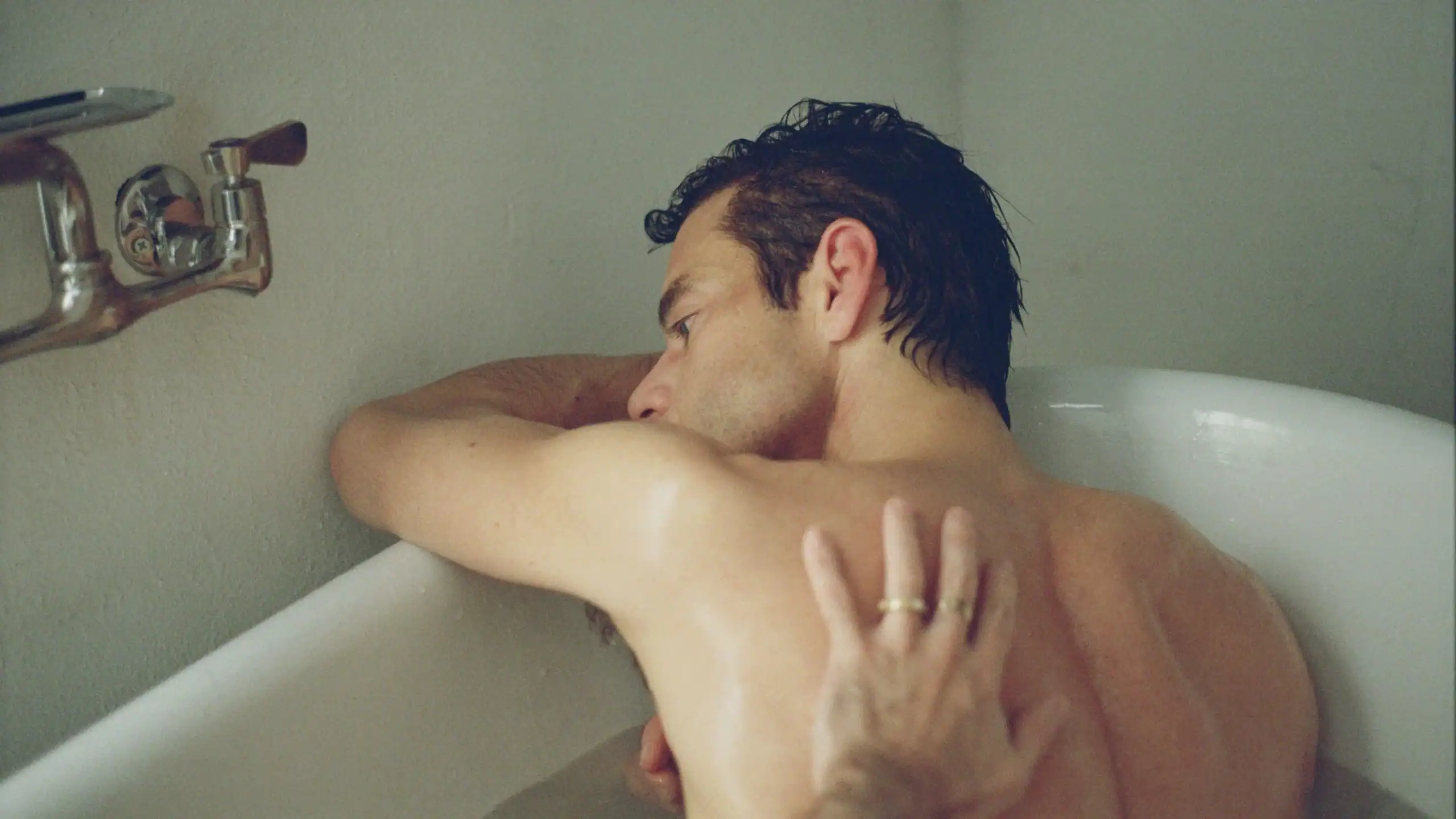
Ira Sachs brings his latest film, The Man I Love to the Cannes film festival in competition. Previously directing the ever so resonant Passages and the recent mundane drama Peter Hujar’s Day about a writer struggling in New York. Ira set his sights on going back in time to a place that’s familiar to him and bringing forth his newest collaboration with Oscar winner Rami Malek for a story set in 80s New York, exploring a queer actor Jimmy George, seemingly at the end of his life during the AIDS crisis, hoping to give one last performance. Rami and Ira discuss their experience working together on their latest film, highlighting the changes in the industry over the decades and telling a queer story that they can both connect to as an outsider and as artists that champion telling stories of struggle and perseverance through a delicate perspective.
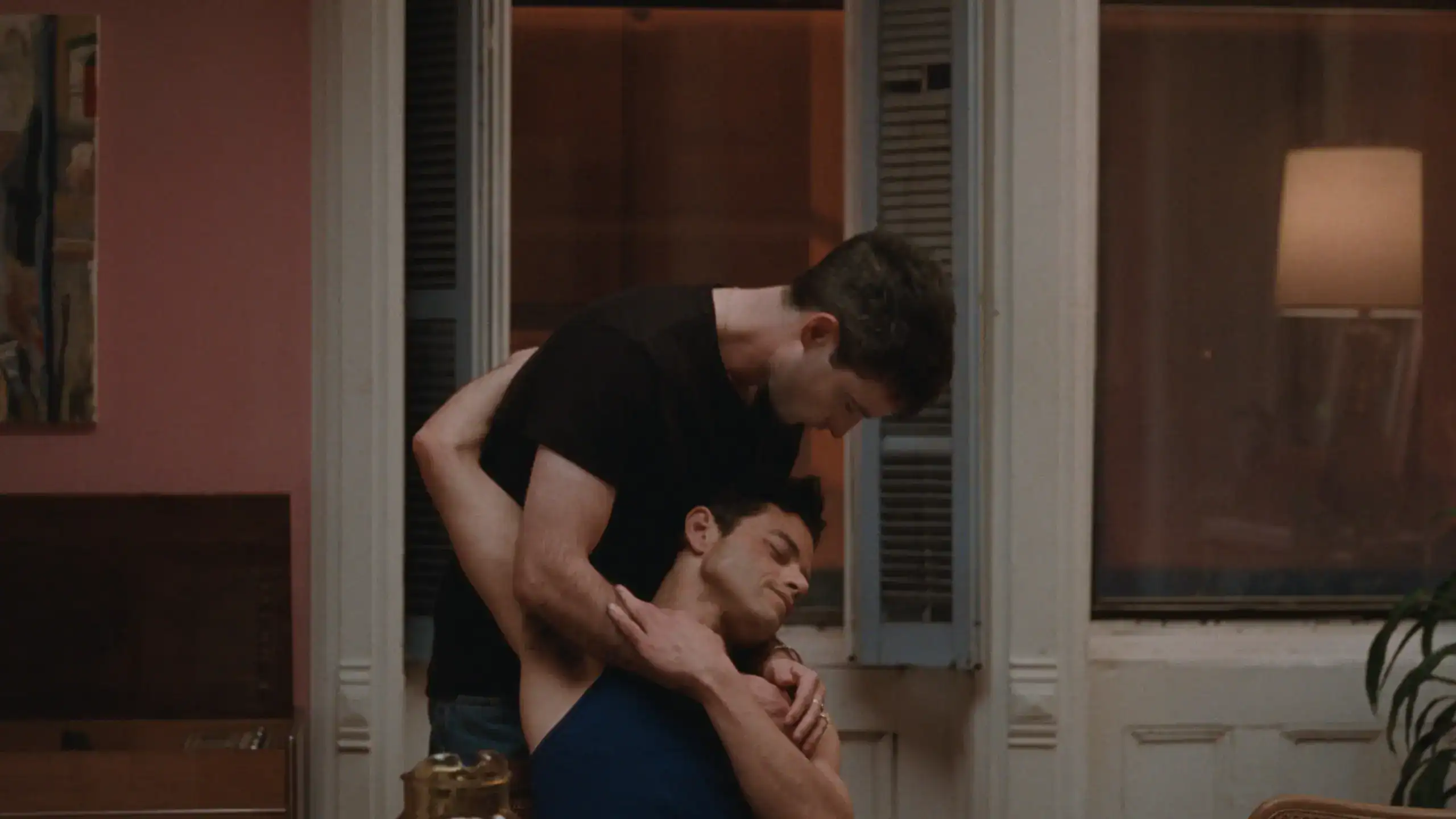
The Man I Love (courtesy of Big Creek Projects)
Soundsphere] How are you feeling ahead of the big Cannes premiere?
Rami Malek]I think I’m constantly taken aback. I never get used to these moments. It’s like the moment you get a job that you’ve auditioned for or been in. Hopefully you just wanted or cherished or thought might come to fruition. But there’s always this unexpected feeling that you never know what’s going to happen, and Cannes is something I never, ever expected. And the fact that we’re here right now is still a moment I’m trying to savour and feels a bit surreal. I mean, it’s Cannes. Its extraordinary.
Ira Sachs]I think for me, I have so many layers of memory. I’ve been here twice. This is my second time with a film, but I started coming here in the early 2000’s and basically putting on a suit that I bought, unlike this one, and would just knock on doors and look for money. So the idea of coming back here 25 or 30 years later and actually having been able to create a sustained career making movies that are very personal to me seems something like I didn’t necessarily expect was possible.
S] What has changed these past 25 years when knocking on doors, asking for money to sustain your career, and to tell stories like The Man I Love?
Ira Sachs]Well, everything has changed since then. So many things. I think there is continuity. One of the things about this film in particular, is people refer to it as a period film, but I actually feel like it’s a film that’s very much in continuity to my own life, having moved to New York in 1984. So, in a way, I’m making a film that feels like a film about the present. The things that have changed for the industry have been numerous, and we could be here all day to talk about them. But I think the challenge for filmmakers like myself in New York is to figure out, and in America, is without any support of the government or state support, how do you keep going? And I think, yeah, there’s not so many of us who’ve been able to do that. But I would also say you still have to knock on the door. My producers who are here, David Siegel, Scott McGehee, Mike sprinter, they said yes, but it wasn’t like everyone said yes. I still have to knock on doors.
S] Rami you wanted to work with Ira for a while, what drew you to Jimmy specifically that made you want to star in this film?
Rami Malek]I’ll go back to Ira first and foremost. The canon of work speaks for itself. What a unique artist that I think we can all cherish. These are timeless films that Ira has put into the world. I think they will live on and we will constantly go back to them for feelings that certain aspects of cinema don’t always give us, but Ira always delivers. There’s great intimacy and empathy and a certain ‘Je ne sais quoi’ European style about his films that not many American filmmakers can pull off so elegantly but it’s something that comes from the soul and has so much meaning. You keep discovering meaning in the characters in the story, and they just last with you. I wanted to work with someone who I knew I could lean on, depend on, collaborate with, and make a piece of beautiful art that we both saw great pleasure in. That’s what resonates in Jimmy’s character, a man seeking great pleasure and intimate moments every second, trying to grasp every ounce of that in his life, even though there is this sense that life may be fleeting, but pushing that away, as we all do at times. But this is a bit more grave.
S] This film deals with the AIDS crisis in 80s New York, how was it like to develop that story?
Ira] Well, I’ve been working with my co-writer Mauricio Zacharias for 15 years. This is our 6th feature that we’ve made together. And really, from the beginning when we started talking to each other, we both were gay men, and he was living in LA, I was living in New York. But we kind of went through this, maturation process, this time of being young in a really intense, intense world. And we were trying to figure out how we might share that through a film. And it took a long time in a way, to have the distance. I think what we came to is that we wanted… We actually started a script that we got about halfway through and we’re thinking this is not the movie. That was a script about death. We realised, you can’t really make a film about death. You can only make a film about life. Right? Because we’re all, sorry, we’re all going to go. But what we’re doing now is what is cinematic, what is dramatic, and what is actually quite true. So, it’s a film in which I tried to put into everything that I could imagine that I would miss the most when I wasn’t here. I will say that just by sitting here with Rami, I think our souls are in this film together in a significant way. We made this together and I think there is no film without his performance, and without him literally bringing in everything that is a part of himself. We really were a mirror for each other in this film and the making of it.
Rami]Truly, and I can say the same. Ira brought out a performance in me that I don’t think I would give in another situation because of the belief. But Ira is definitely an actor’s director among all the things that he can do and we really did believe in each other. We did all the work ahead of time. We have constant conversations and it was a beautiful collaboration to create. Before we were actually filming, we were properly creating and developing a relationship that would give us some type of ease to be able to speak to each other about almost anything. We could and we did, and even after the film, and post as well.
S] We know Jimmy in terms of his emotionality and the many layers to his character. But there’s also learning to sing and playing guitar for the role. What went into your process of finding who Jimmy is?
Rami]Well, Ira gave me quite a bit of research. I was introduced to some great films. We watched Beau Travail. We watched a lot of Claire Denis, Fassbinder, I mean, you name it. Tell me more. Where do we go? The Mouth Agape.
Ira]For me, I try to figure out a language that we’re experiencing together, but really, my job is to build a world and that we really committed to making a film, a New York film in New York City. A lot of my job was filling the world around Rami so that he didn’t have to imagine this time or period. I think the thing it’s not New York for its exteriors in this movie, it’s New York for its people. The thing about New York is, actually the people are still really great and really interesting, driven and unique. That is kind of this ensemble that we built from people who are living in the 80s in the city. That’s the part that they connect most to, I would say.
Rami]I was picking up a guitar to learn a song that may or may not have made the film, learning piece of choreography that may or may not have made it into the film. So, I was constantly busy because I didn’t know what he was going to throw at me. Things would constantly change and evolve, and that was a beautiful thing. We would look at different performance artists from the 80s. We’d look at Arthur Russell, we would look at Ron Vawter from the Worcester Group. Frank Maya. I was getting this wild education from the 1980s that I never would have had. It was before the time of globalisation where you have everything at your fingertips. It’s almost as if you were getting handed this… In the way they must have been sharing a cassette or a videotape of something, or actually going there and seeing these live performances. What I loved about that is it infiltrated the world around us, in the design, costume designer Megan Bowman created this incredible world that was very specific to that. She would bring up this concept of punk rock that would be very different in New York rather than it was in San Francisco, and little nuances that you had to think about that you could bring into the character.
Ira]For most of you who haven’t seen the film, just to say that, there’s many dramas in the film, but one of them is Rami plays a character who’s a part of a theater group, and they’re trying to put on one possibly last great show that he’s going to star in. So there is this kind of narrative suspense element to the film. Is the show going to go on? That gave us kind of a direction where we could, as I said, talk about what is possible, not about what is impossible. There’s a theater world that he lives in. There’s the world of his home. He’s in a partnership with a character played by Tom Sturridge. There’s a young guy who’s come to New York, played by Luther Ford. There’s some other relationships. Things happen. But in some ways, it’s a backstage theater drama that’s the genre, if you were going to call it one.
S] As this film is multi-genre, a key element here is the idea of queer cinema and the importance of queer storytelling. How have you seen the industry change?
Ira]It’s gotten worse. There’s this idea that progress grows in one direction. As we can see, that is not always the case, right? Look at what’s happening in America right now in all sorts of different areas. What I want to know, what will inspire me and what will make it like the images that I have permission to make. I go back to the 70s and 80s and I go back to filmmakers like Pasolini,Fassbinder and I go back to a wonderful film called Taxi Zum Klo, made in Germany in 81. I mean, the images, they blow your mind, and I do show those all to Rami because we’re allowed to make anything. But there is also, in globalisation, a slimming of what seems allowed, right? Because everything needs to be translatable, economically. So, that has narrowed the possibility of what I call local cinema. A cinema in which people are actually telling the stories of what’s happening right in their homes, and in their city, and in their town, so that’s more difficult and that’s more difficult for gay people and queer people as well.
S] Rami, you have been very unafraid to play queer characters quite famously. With Bohemian Rhapsody, and now this film. What was it about Jimmy and the opportunity to bring this complex romantic story to the screen?
Rami]I fell in love with Jimmy. All his contradictions. At times, I would actually come up to Ira. Are people going to like this character? He can be very selfish at times. He can be very narcissistic. He’s very different to that other character that I love so much as well. There’s a great drive and passion that Jimmy has, and we would often refer to him as the guy who, he might or might not be featured in The New York Times, but he’d he definitely be on the cover of The Village Voice. There’s a soul in him and a feeling of a desperate need to create. That’s what keeps him alive. I could just connect to that, I feel like I have a similar sensibility, it doesn’t need to happen day to day for me. And I mean, with the right project, this definitely being that. But for Jimmy, there’s a passion, there’s this zest for life in every aspect in having a beautiful dinner with friends and sharing ideas in this way that I don’t know, we do communally, the way I was referring to that happened in the past. That’s quite unique and gorgeous about this human being who is trying again to live life to the fullest, fill it with so much pleasure and pride, and intimacy and relationships in his art and all during a time where there’s a tragic theft of life surrounding him. So, there is that ticking clock and that real desperation to create, that I found magical about this man.
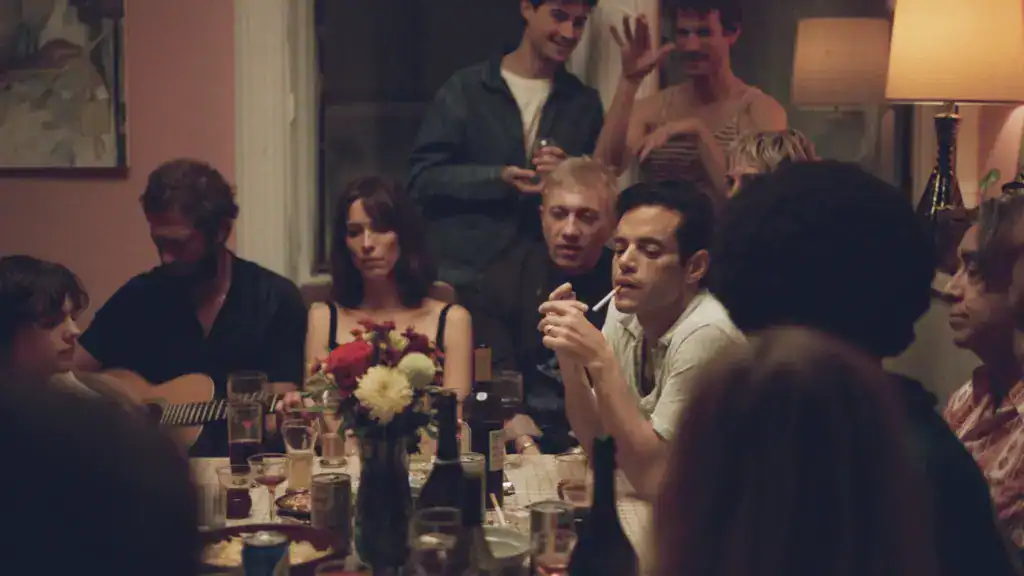
The Man I Love (courtesy of Big Creek Projects)
S] On the idea of creativity as survival. This film is about making art. Making art as a refusal to disappear in Jimmy’s case. How do you relate to that in your work as an actor and in the choices of projects that you’re making?
Rami]I love that. I did feel it was this almost…It was a refusal, this stubborn refusal. I don’t know that it’s actually that stubborn. It’s just a will to survive, in the world of creativity, against all odds. There’s something quite human about that. And to your point about how limited time is, how much can we jam into that time that we are actually proud of? I’m more considerate about the choices I make, how they’ll affect me, but moreover, how they’ll affect society. Will they land? Will they leave an impact? I very much think that this film will. I think it will resonate with many people, people who lived in that period and beyond. To go back to Ira’s films, they stay with you, they stand the test of time and I think this character will. So, I’m incredibly proud of it and what we’ve achieved.
Ira]I also want to say that this film for me and I think for Mauricio, my co-writer as well, came out of the pandemic. I mean, where I think all of us had a feeling of something was over, right? I think specifically for a lot of artists, there was this sense, can we still make work? Will that be part of our lives anymore? I felt depressed, I felt like I ended up starting to write because I was thinking, well they can’t take that away from me, right? They can’t take the computer and my fingers away from me. The world might take away cinema. But I think this idea that that something that would connect me to myself through the creation of art felt very essential at that time. I’m just trying to imagine what Cannes was like in the late 80s and how it’s changed. What restaurants were like and how groups of people gathered and how they talk to each other. Someone was telling me that you’d learn about a party, this was maybe a little before that, by a flier that was on a wall at the press booth, like come to the party tonight. That’s already such a different and in a way, more tangible way of being together. So, I hope everybody’s having some of that here, a little bit.
Rami]There’s always another film bubbling over here.
S] We have seen Bohemian Rhapsody so we know that you can perform for mass audiences. But this required a different type of singing and a different type of performance, more intimate. One of the most raw moments in this film is the performance of Look What They’ve Done To My Son Ma.
Rami]It can be quite nerve wracking still. I mean, I remember maybe after the first take of that shot, I was wearing a shirt similar to this color and it was soaked. I’m not someone who usually sweats. I was thinking, “oh, okay, this is happening again”. You better take a beat, step aside, calm down. Singing live in front of an audience, they’re hearing it for the first time, and there’s a beauty in that. There’s a power in that. I think that’s something that Ira wants to capture in every element of the film, something that is being created in the moment, that just happens to get captured on celluloid. There is at times, this simultaneous thing that’s happening and it’s this adrenaline rush, but this actual trepidation. I feel like in those moments, I love to rise to the occasion. Sometimes it happens, sometimes it happens on the first take, sometimes it happens on a fifth take, sometimes it ends up on the cutting room floor. But I do enjoy performing. I guess that’s why I’m here. But there’s a very raw element to the music in this. Picking up a guitar, not playing it perfectly. You can hear that in the film, and I think it gives it a particular feeling of authenticity that you don’t often see in film.
Ira]I want to just add one thing as we edited, started it…I work with an editor named Afonso Gonzalvez, and we’ve been working together for 30 years. When we were in the cutting room, one thing that became apparent to us around the songs, and particularly Rami’s performances, is that the songs become a form of dialog. I think then, that they’re really working for the film. They’re not about the song, they’re about how the song connects the character to the other people in the room and to the audience, and it’s a different kind of song than in that other film, right? Which is something around popular music, which is its own beautiful thing. But this is really a different kind of film. I mean, I think about what what I love about Judy Garland in A Star Is Born and what I love about Ida Lupino in the original, The Man I Love is that the songs become language between people.
S] Looking back at your Oscar win, during that speech, you took a space to acknowledge the historic nature of becoming the first Egyptian to win that Best Actor prize. You didn’t speak about the grandness of it but the young boy who was trying to find his own identity growing up. What have you heard from others that meant for you to be on that stage?
Rami]Well, I think that one of the greatest achievements of receiving that award is the hope that it’s imbued in so many people all over the world, especially where my family is from in Egypt, and the surrounding neighbourhood countries. But all over the world, I think people can relate with what it feels like to be an immigrant or first generation citizen in any country. That comes with some weight. To be able to connect to that accomplishment in some way and hopefully inspire anyone, young people, people my age, people who are still trying to figure things out in their life. It fills me with some sense of pride that is, it’s greater than even doing the work itself, for me, it’s something I take more pride in. I thanked my mom on that stage and I continue to thank the people that helped me get there. All the great casting directors that helped me along the way. Cassandra Kulukundis won an Oscar and she put me in The Master when I was younger. Francine Mazur was nominated this year. I remember auditioning for her. While we’re here, I was on the carpet and I was asked women who I admire and my mother’s name came up immediately, but I thought about makeup designer Jan Sewell that I’ve worked with for a number of years now. Fay De Bremaeker is here. Jan is someone, who brings such authorship and intelligence and architecture to a film that sometimes I can count on someone like that in the way I can a director. There’s so many women that I find as the majority of my mentors in life. I could continue to speak to Ellen Miroknick as a costume designer. I’ve done two films with Ruth Carter, all these incredible women that I think have helped shaped me as a human being throughout my life, that I’d like to give a shout out to.
Ira]Both our mothers are alive and well and would be, very proud, a little bit shy, but they would have their own take. I will say that when I first started working with Rami, he was on zoom with his mother and she said, “Take care of him, take care of my son.”
Rami]She was very aggressive. I was like, take it easy ma.