

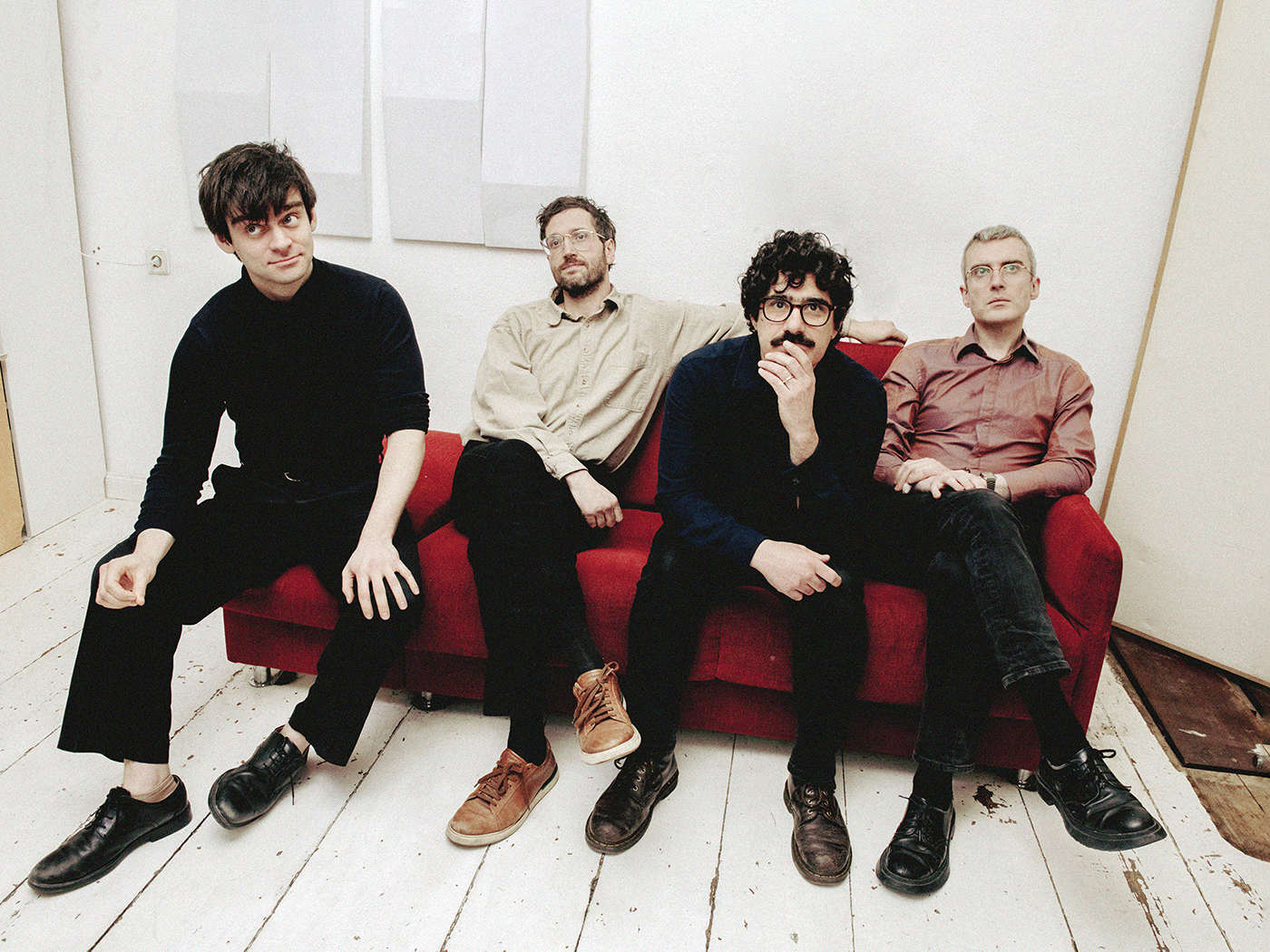
With all of its overlapping loops, interlocking cycles, crafty algorithms and escalating intensity, Horse Lords’ music may cast back to an era when bands playing similarly complex music attracted a peculiar adjective. At some point in the mists of the 1990s, “math” became a handy descriptor for alt.rock, hardcore and metal acts that took an unconventional approach to matters of structure and rhythm, one more rooted in experimental music, free jazz and non-western musical modes. You could usually find a copy of King Crimson’s Red in the members’ collections, too.
Like most of the bands themselves – Drive Like Jehu and Polvo being the mightiest examples – the tag stayed a niche concern. But for many makers and fans alike, “math” remains a nerdy badge of honour, a statement of defiance toward those who’d rather keep it simple, stupid. That attitude was perhaps best espoused in words used on a T-shirt for mathcore greats The Dillinger Escape Plan: “Math is hard – and so are we.”
As much as Horse Lords may sometimes deviate from any such predecessors, they are equally dedicated to the task of making music whose precisely calibrated nature never impairs its most visceral effects. Since founding the band in Baltimore in 2010 (three members are now based in Berlin), Owen Gardner, Max Eilbacher, Andrew Bernstein and Sam Haberman have explored and absorbed a wide variety of influences while maintaining a loyalty to just intonation, the drone-friendly tuning system favoured by La Monte Young, Terry Riley and other pioneers of American minimalism. (They recently acknowledged their debt to the renegades of contemporary classical by teaming with composer Arnold Dreyblatt on 2025’s Extended Field.)
Within the quartet’s microtonally oriented, meticulously constructed maelstrom of activity on albums such as 2022’s exhilarating Comradely Objects lie identifiable shards of raga, psychedelia, post-punk, mutant disco, gamelan, West African highlife, Tuareg blues and bluegrass, too. Hell, there was even room for a memorably mantric application of bagpipes on 2020’s The Common Task.
On Demand To Be Taken To Heaven Alive!, Horse Lords’ sixth album since 2012, they introduce another new element: the human voice. This hardly constitutes a shift away from their mathematical inclinations toward pop-oriented accessibility. Evoking both Sacred Harp choral singing and the otherworldly ululations of Meredith Monk, Nina Guo and Evelyn Saylor’s vocal contributions are largely utilised in much the same disorienting way as Bernstein’s blurts of alto sax, and further blasts by guest horn players Madison Greenstone and Weston Olencki throughout.
The matrix of details and ideas on Demand To Be Taken To Heaven Alive! can be as formidably dense as it is on all of the band’s recordings. Yet when compared to their sometimes maddeningly repetitious exercises alongside Dreyblatt on Extended Field, the music here benefits from a restless dynamism, such that they never double down on any particular gambit for too long. Indeed, the album’s first stretch is dominated by shorter pieces like “Eureka 378-B” and the three-part “Rotation”, all of which playfully situate electronically manipulated fragments of Guo and Saylor’s voices in the Horse Lords soundworld in assorted ways. Things grow more elastic and extended with “Brain Of The Firm” and “First Galactic Utopia”, both of which ride the kind of loping grooves that Liquid Liquid and ESG used to entice a long-gone generation of New York scenesters.
As the album progresses, it becomes more evident that the early section largely serves to introduce variables and elements that become ever more ingeniously intermingled. On “Before The Law”, drummer Sam Haberman furrows into a hypnotic, Jaki Liebezeit-worthy pattern as droning horns push against more agitated guitar figures. The latter morphs into the passage of John Fahey-style fingerpicking that opens “After The Last Sky”, which gradually swells into a menacing thundercloud of horn ballast and guitar distortion.
With “A City Yet To Come”, the vocal elements achieve their strongest prominence, albeit just barely winning the fierce battle for space with jazz skronk and squelchy electronics. Fever-pitched and avidly surreal, it evokes not so much those math-rock antecedents as the furthest fringes of the post-rock moment happening elsewhere in the decade, especially Stereolab’s caustic, cryptic collaborations with Nurse With Wound. Likewise, the title track shares the steely intelligence and perpetually shape-shifting ways of Tortoise’s “Djed”, another landmark recording of the era that opened up avenues now explored with too little frequency.
Thus does Demand To Be Taken To Heaven Alive! leave the final impression of music that has been carefully planned out in scrawls of black marker on some giant whiteboard yet still exudes a bounty of nervy spontaneity and vitality. If there’s a math equation at the centre of it all, this one continually produces highly unpredictable and unusually captivating results.