

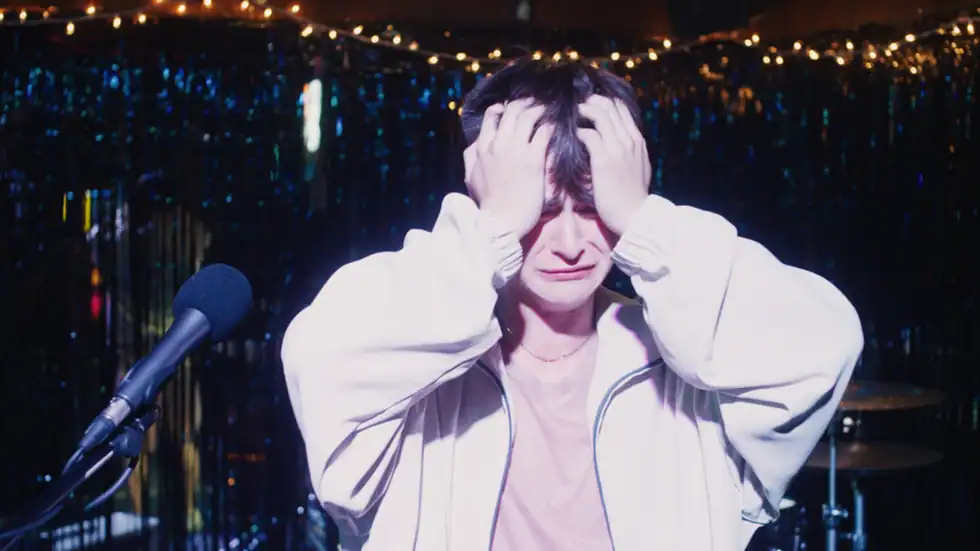
Our Hero, Balthazar begins and ends with tears. At a Manhattan high-rise, a wealthy teenager breaks down, sobbing about how lonely he is. His suffering, however, is performative; his identity is a construct. Filming himself on his iPhone, Balthazar Malone (Jaeden Martell) isn’t seeking genuine companionship, but the social media followers and digital clout that such videos — which frame him as a sensitive young man — can garner. Oscar Boyson’s directorial debut, which he co-wrote with Ricky Camilleri, depicts the unnerving chasm of a world in which you could virtually connect to anyone, but simultaneously be detached from any real emotion.
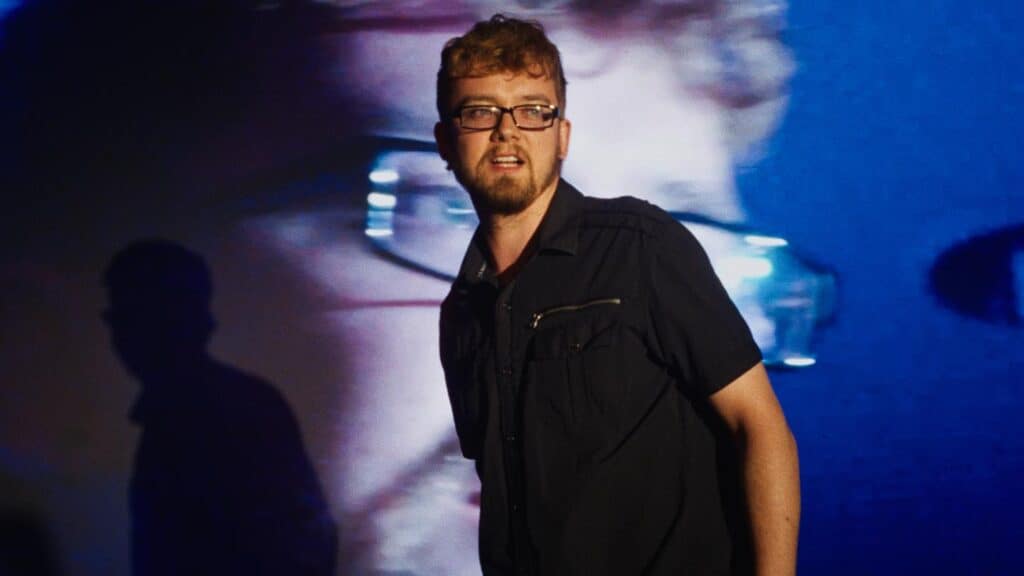
Balthazar expresses an interest in anti-gun rhetoric to impress an activist classmate he’s attracted to, but his manufactured persona quickly falls apart, repulsing her. In a desperate bid to regain her trust, he travels to Texas, not only convinced that the internet troll he’s been chatting with is a would-be school shooter, but that he can stop him.
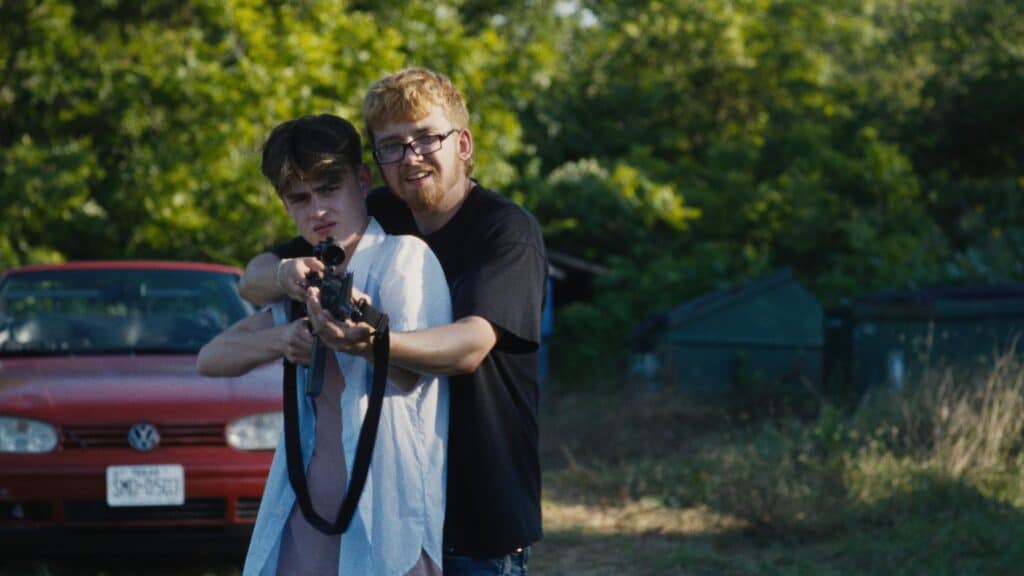
Enter Solomon Jackson (Asa Butterfield), whose cruelly exploitative father, the looming risk of eviction from the run-down trailer he shares with his grandmother, rejection by a female coworker and recent job termination suggest the perfect storm of circumstances designed to foster a burning resentment that can only spill over into an act of horrific violence. With a deft hand and a darkly comic touch, however, Boyson and Camilleri complicate our assumptions about the film’s heroes and villains, crafting a chilling, unpredictable and piercingly heartfelt drama about how the younger generation’s gnawing desire to be seen and heard manifests itself.
They spoke about the the film’s investigation into the male loneliness epidemic, their research into school shootings and the challenges of getting a film dealing with heavy subject matter financed:
Soundsphere] With Friendship, Lurker, Twinless and now Our Hero, Balthazar, there’s been this spate of films about the male loneliness epidemic and how it’s tied to the act of performing — you pretend to be someone you think others might like, which is ironically what keeps you from forming a real connection with them. Could you talk about your approach to that in the film, particularly with regard to how easy the online world makes it to adopt an identity?
Ricky Camilleri]A real question! Thank you, Gayle.
Oscar Boyson] I don’t think of myself as super online, but I’ve had a social media following and have met up with people who I’d seen online and didn’t know before. At the height of me having fans on YouTube and Instagram, young people would message me to ask if I’d take a look at their YouTube channel and tell them what they were doing wrong. I’d go to this 11-year-old kid’s channel and see their vlogs and realize they were clearly copying someone else. I would feel so bad for them because you just want to say, “Hey, go play with your friends. Why are you trying to be an influencer or a brand at 11 years old?” I have a lot of empathy for boys growing up that way, and that made me feel closer to the characters.
RC]The ‘male loneliness epidemic’ wasn’t really a conversation when we started writing this movie. It was after Trump won the election in 2024 that people started writing all these op-eds about how the male loneliness epidemic was fuelling a push to far-right politics. They were trying to figure out how the two were connected.
OB] Stuff like: Have we abandoned our boys?
RC]Yeah, we wrote the movie in 2022-2023, and shot it in 2024. And so we felt on the pulse by the time it came out, but it wasn’t really about male loneliness. We were thinking more about performance. If you’re performing all the time, you inherently don’t know yourself. So you’re lonely and also seeking some sort of gratification and validation that isn’t intrinsic to who you might actually be. So you’re left with no satisfaction. Maybe you get all the likes in the world but you’re not…
OB]…self-actualised.
RC]That’s something we’ve seen online for so long, particularly during the pandemic. You couldn’t have an opinion without having absorbed what the opinion you were supposed to have was. You couldn’t feel something without knowing how everyone else felt about it first. You couldn’t feel anything without reading the commentary first. So you’re commenting on the commentary and that way, things become dead so quickly. A news event happens and I’ll have consumed so many takes on it just one day in, that two days later, if I meet someone who’s hearing about it for the first time, I don’t want to talk to them about it because I’m already over it. What would be three weeks’ worth of material and opinions in the past is something I’ve consumed in just three hours now. What does that do to a person and how does that fuel your ability to connect with someone outside of the online world? We were grappling with those feelings and ideas, and the male loneliness epidemic naturally became part of it.
OB] Ricky and I met when we were 17. When you’re searching for authenticity as a teenager, you want to find the music that rings true to you and so you go to the record store and talk to the people there. Those experiences shape your idea of authenticity, which helps you self-actualise.
RC] I hate to be all, “In the old days…” but in the scenario Oscar’s describing, if you start performing an identity because the guys you meet at the record store are punks or goths, you’re still in a physical community with the people you’re performing for, which allows you to grow out of that identity as you get older. With the temporary permanence of everything online, you don’t get that chance to grow out of it because you’re not physically interacting with people and so you’re not self-actualising in the same way.
OB]And if you’re someone who has a little bit of a following online, those people aren’t going to like it if you try to change who you are. The algorithm’s going to make you feel like you can’t change. But changing your mind is a positive thing — that’s life, that’s growth. Everyone should be allowed to do that. Everyone should constantly be doing that.
RC]Now, no one changes or grows. They just talk about changing and growing online.
OB]The pandemic was so fresh when we were writing this, and the thought of those kids who had to spend their 12th or 13th birthdays inside and alone at a time when everything was being performed and the only way to see people was through this performative lens was so sad.
You’ve said the impetus for Our Hero, Balthazar came from the 2022 Uvalde shooting, and reports that the shooter had messaged a woman in Germany but wasn’t taken seriously. From there on, how did you start to build this world? What was your initial research like?
RB] That was where the first idea came from. A girl who didn’t know the shooter personally received a DM that said, “I just shot my grandmother, I’m going to go shoot up my elementary school.” And she responded, “That sounds cool.” But she didn’t know him, she didn’t know it was real, she was just 13 years old and she was from another country. People online still tried to dox her. Even mainstream media began questioning whether she should’ve done something and whether she should’ve been prosecuted for not speaking up. That felt like a microcosm for what it might feel like to be young right now, where you’re inundated with all this societal rot that the adults have created, and yet you’re the one expected to do something about it. They don’t have to take responsibility for it; you do. They’ll throw you under the bus and then talk about what Millennials and Gen Z are like. That was the engine of a story about a kid who had the means to do something, and tried to do it.
So a lot of our early research was just watching interviews of school-shooting survivors, shooters and their families. We also read a lot of their diaries. We were grasping for things we could use and throwing them into a document and seeing what character beats could drive the narrative forward. Very early in the process, we were doing research into the psychology of shooters.
OB]We moved on quickly and just followed through on the emotions of the characters. We started thinking about things like what their bedrooms would contain and what cars they might drive.
Even despite their socio-economic inequality, there are similarities between Balthazar and Solomon — they both have absent fathers and lack communication skills when it comes to women. By the end, however, you realize their identities are the opposite of their crafted personas. Solomon is the tender-hearted boy Balthazar pretends to be, and Balthazar is really the cold-blooded killer Solomon was masquerading as online. Could you talk to me about crafting that?
OB]The movie’s about a sociopath who’s pretending to be a crybaby, and a crybaby pretending to be a sociopath and when they actually get together in real life, the masks come off. As far as crafting it, everything begins with the character. You’re drawn to opposites whenever you’re telling a story, and then as you go on, you start to see how the two could complement each other. The final music cue we created was for the scene in which Solomon gets fired at his workplace. We used the same music for when Balthazar gets told off by [his crush] Eleanor. So there’s some stuff, especially at the beginning, that’s a conscious creative decision.
RC] The movie initially started as being about a performatively woke person who got punished by trying to be that in real life. In the first draft, Balthazar met Solomon and found out that he really was a psychopath. Solomon wouldn’t have changed at all. That draft came out of my frustrations — I don’t love the trend of performative activism online, which is done for likes, as opposed to actual activists who are doing the real, boots-on-the-ground work. But once we wrote that draft, it was just flat. It wasn’t going anywhere and we felt like it could just be a 25-minute-long short film. That’s when we started figuring out how to change the roles a little bit, how to show the characters’ masks slipping off. It was born out of this sense of, “Okay, just being angry at one type of person doesn’t make a feature-length screenplay. How do we write a whole movie?”
OB]Because the characters are teenagers and their brains are still developing, they don’t know why they do things. We initially wrote Balthazar as someone who was more of a master manipulator and a sociopath and later realized that wasn’t interesting. So we pulled back and showed you a kid who has all this stuff bubbling under the surface and may not even really know about it. That felt richer.
RC]There’s something about being a teenager and not knowing what things mean to other people yet. When I was 16, I never tried to make out with a teenage girl while footage of a violent incident was playing [as Balthazar does] but I did show ultra-violent, crazy movies to girls because I thought they’d like them. I was sharing what I was into. So we started with that perspective and thought about who that kid would be.
OB] It’s also a consequence of not having a dad around to tell you, “Hey, that’s not okay.” You remember it so well when you do something bad and someone tells you off.
RC] When your dad yells, “What the fuck are you doing? Get out of here!”, you’re like, “Okay dad, I’m sorry, I’m sorry, I’m sorry!” Everyone thinks that young men without fathers are missing role models, when what they’re actually missing is an authoritative presence who yells at them and makes them scared. Just to backtrack though, mothers can also be an authoritative presence.
So many characters in this film are exploitative, from Balthazar and his performative crying over school shootings he’s not experienced to Solomon’s dad, who exploits him financially, to the landlord increasing Solomon’s rent, putting him and his grandmother at the risk of eviction. Tell me about creating this uniquely cruel world.
OB] This exploitative, cruel world…we’re just trying to reflect what it feels like in the United States.
RC] I’m sure there’s an argument that other countries can feel like that too at times. But, as Americans and as artists living in America, we’re subject to that exploitation. If we could’ve jammed the issue of healthcare in there somewhere, we would’ve. But I guess Solomon’s grandma is sick, so that counts. The question that we get sometimes is, “Why is class such an aspect of the movie?” And to us, it’s just like, “Why not?” It’s an American movie, why wouldn’t we talk about class and exploitation and capitalism? It’s a cruel world, but it’s also a cruel world for every single character. Outside of Balthazar, Solomon’s dad is maybe the most evil character in the movie but he’s an ex-convict, he’s doing what he can, he’s trying to make some money. Yes, he’s exploiting his son but maybe he’s been exploited his whole life too. Maybe he doesn’t know any better. Empathy comes with knowledge, it comes from being raised well and from being taught. And maybe he just never had that. This is really a movie about the structures that create such exploitation and how people end up having to operate within them.
Could you talk about the challenges of getting a project like this financed? What kind of feedback were you getting? Were you being asked to tone it down?
OB]It’s an independent film. We have a lot of different investors. On independent movies I’d worked on before, it was usually just one entity cutting a cheque. On this one, we had a lot of people cutting small cheques. That made it a little bit harder but also gave us more people to share the success with. It’s really hard to find people who have any appetite for risk in this space. Any time you have “school shooting” in your synopsis, like ours — even though the movie doesn’t feature one and isn’t really about one — you will immediately get pushback. But the good thing is that if one entity said they’d do the movie in exchange for becoming our creative partner, who knows what that version of the film would’ve looked like? Once we had a ton of different financiers, none of whom were expecting to tell us what to do creatively, we had no one else to blame our choices on.
Since Gen Z slang is ever-evolving, how did you develop the language that these two boys speak?
OB] We knew that we didn’t want to try and stay up-to-date with trends with regard to language and slang. That would’ve dated the film and made us sound like guys who are trying to use words we don’t really know how to use.
RC] Sometimes knowing what you don’t want is better than knowing what you want. Knowing what you want gives you too many options, but when you land on something you don’t want, you can very quickly say no and cut down your options. We didn’t want to mimic 4chan language, internet language or any temporary Gen Z slang.
OB] We only do that in interviews.
RC] Yeah, it’s lit. But there’s a recent movie that came out that didn’t abide by this rule and I found it so frustrating. If there’s too many “dude”s or “man”s or “bro”s in a scene, even if that’s how that generation talks, I get very bored. It feels like filler and not dramatic dialogue. If your characters don’t speak like that, you’re driving momentum better.