


Some films fail because they have nothing to say. Outcome is more frustrating than that. It has a target, a mood, a star, and a premise with real venom in it. What it lacks is the nerve to follow through.
That is the problem from the start. Jonah Hill has built this film around a Hollywood ecosystem that should be easy to cut open: fame as insulation, scandal as currency, apology as performance, image management as a full-time religion. There is a good movie in there somewhere. Probably a nasty one. Probably a funny one too. Outcome never quite becomes either.
Instead, it drifts. It circles. It hints. It looks at rot without wanting to get its hands dirty.
That makes the film more disappointing than disastrous. This is not a train wreck. It is something stranger: a satirical drama so wary of its own sharp edges that it files them down scene by scene until almost nothing really lands. You keep waiting for the film to stop observing Hollywood dysfunction and actually cut into it. Mostly, it just stands there and stares.
A Hollywood Satire That Keeps Pulling Back
The most maddening thing about Outcome is how often it seems to recognize exactly what is wrong with the world it is depicting. Hill clearly understands the language of celebrity self-preservation. He knows how public collapse gets repackaged into myth. He knows how damaged men survive if they remain profitable, sympathetic, or narratively useful.
But the film never turns that understanding into pressure.
Again and again, Outcome leans toward something uglier, something more revealing, then backs away before the scene can really breathe. It prefers implication to incision. That can work when a filmmaker trusts silence, tension, or subtext to do the heavy lifting. Here, it feels more like hesitation. The film is forever approaching the bruise, rarely pressing on it.

That is where the satire starts to fail. Not because Jonah Hill has picked the wrong subject, but because he seems oddly reluctant to be ruthless about it. The film wants to critique Hollywood while still remaining half in love with its mystique. It wants exposure without mess. Dissection without blood.
You cannot make a genuinely biting Hollywood satire that way.
Keanu Reeves Is the Reason to Watch It
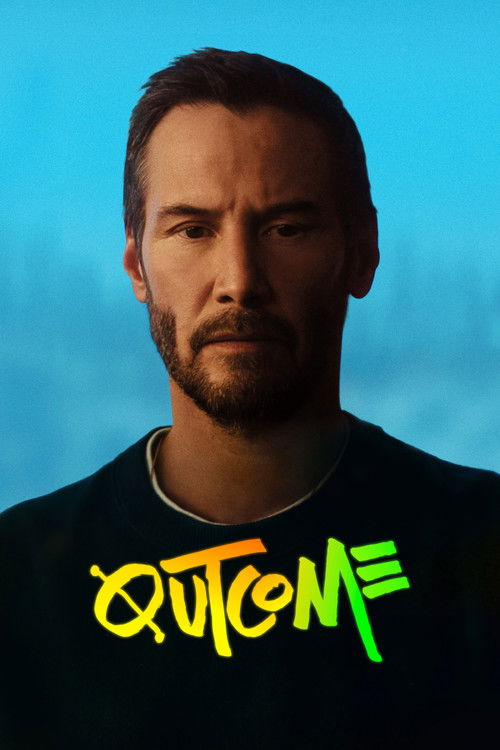
If Outcome works at all, it works because Keanu Reeves gives it a center of gravity that the script itself cannot provide.
He does not overplay anything here. In fact, one of the film’s strengths is that Reeves refuses to force weight onto scenes that have not earned it. What he gives the character is something quieter and much more useful: fatigue, sadness, and the sense of a man who has lived too long inside a version of himself built for public consumption.

It is a smart performance because Keanu Reeves does not chase “great acting” moments. He lets the wear show instead. There are scenes where he says very little and still seems to be carrying the emotional truth of the whole film on his back. A pause lands harder than a speech. A look tells you more than the screenplay does. He keeps finding human details inside material that often settles for atmosphere.
That is what makes the film so frustrating. Reeves is doing the work. He gives Outcome melancholy. He gives it fragility. He gives it the faint panic of someone realizing that self-mythology can harden into a prison. In a stronger film, those qualities would have been the start of something brutal and illuminating. Here, they mostly become evidence of the movie Outcome could have been.
Jonah Hill Has the Eye, Not the Blade
Jonah Hill is not talentless as a director. That is not the issue. There are scenes here with shape, control, and intention. He knows how to create a tone. He knows how to build a frame that suggests moral drift and emotional decay. At times, Outcome almost convinces you that it is heading somewhere darker and more precise.
Then it slips away again.
The film keeps moving between industry satire, character study, personal collapse, and blackmail drama without ever locking fully into any of them. On paper, that blend could have been a strength. In practice, it gives the film a loose, evasive quality. Scenes do not accumulate enough force. They arrive, register, and then fade before they can wound.

That is why the movie starts to feel too polished for its own good. Not elegant. Protected.
There is a version of Outcome that is meaner, leaner, and far more honest about how fame corrodes the people who live inside it. There is another version that plays the whole thing as a tragicomic nightmare. Hill seems aware of both possibilities. He just does not commit to either one. What we get instead is a film that keeps mistaking restraint for depth.
Those are not the same thing.
The Film Understands Celebrity Damage. It Just Never Uses It
What Outcome understands very well is the performance of modern public disgrace. It knows that Hollywood no longer buries scandal. It curates it. It reshapes it. It turns confession into branding and damage into a narrative asset. That is rich material, especially now, and the film is not blind to it.
But seeing a subject is not the same as mastering it. The screenplay keeps returning to the same broad insight without digging deeper or turning more dangerous. The result is a film that feels thematically aware but dramatically underpowered. It knows what celebrity culture does to people. It just has no real appetite for exposing the ugliest consequences of it.
That leaves Outcome in an awkward middle space. Too cool to be fully tragic. Too muted to be savage. Too emotionally arm’s-length to hit with the force it keeps promising.
There are flashes of a better film throughout. A line that bites. A moment that suddenly feels raw. A scene where the mask slips and the movie finally seems alive. But flashes are not enough. Not when the whole thing has been built around a premise that should have left a much deeper mark.
Is Outcome Worth Watching?
Outcome is not empty, which almost makes it more irritating. Empty films can be dismissed. This one cannot. There is something here: a real subject, a worthwhile performance, a filmmaker with instinct, and a tone that occasionally suggests the movie is about to grow teeth. It just never does.

Keanu Reeves gives the film its best and most human qualities by a distance. He brings feeling to scenes that might otherwise evaporate. He gives the story a pulse. He gives it sadness. He gives it a kind of battered inner life that the script cannot consistently match.
But he cannot give it bite. That part had to come from the writing and direction, and it never fully does. In the end, Outcome is less a ruthless Hollywood reckoning than a handsome, half-committed stare into the mirror. It sees the sickness. It flinches before the incision.
Keanu Reeves keeps Outcome watchable, but Jonah Hill’s Hollywood satire is too cautious to leave a scar.
Data sources: FilmDB.co.uk and TMDb. Availability of information may vary, and accuracy is not guaranteed.