

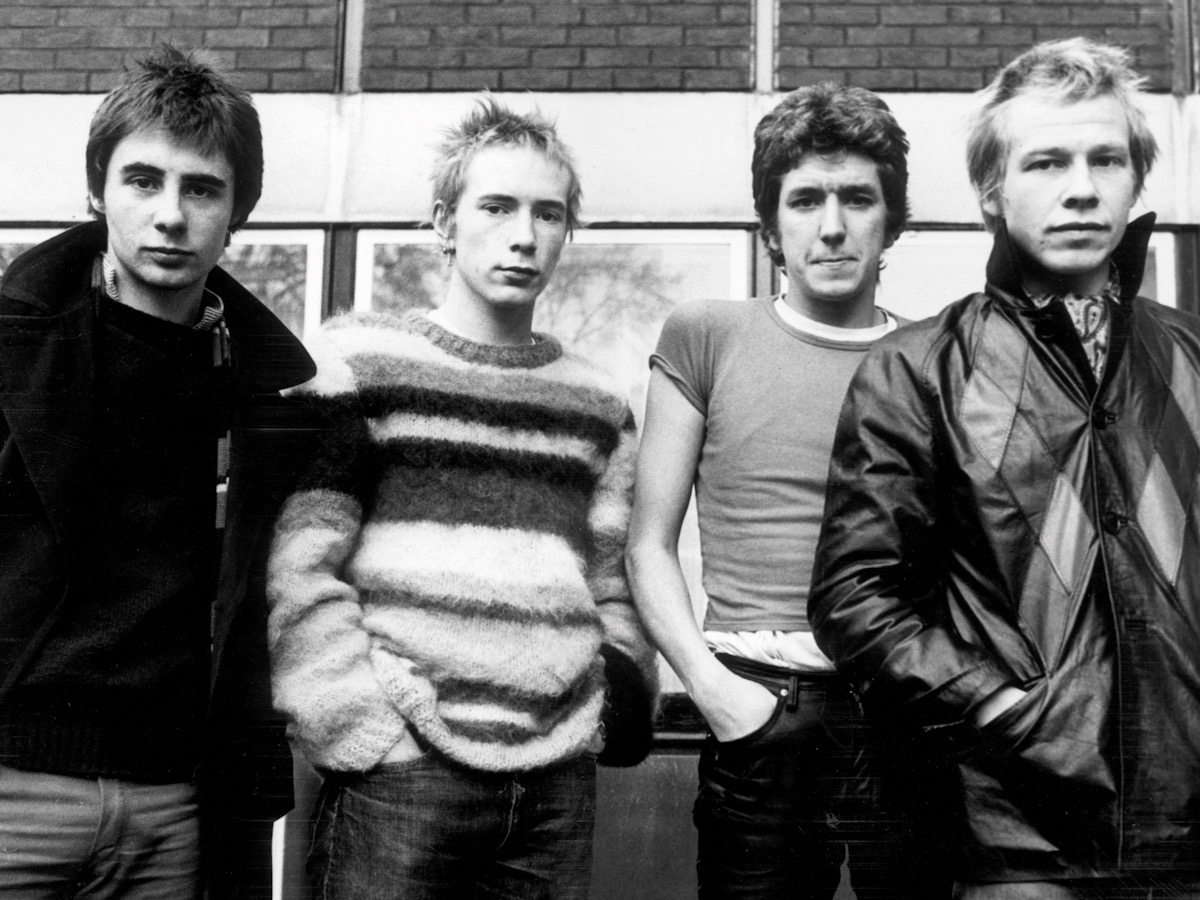
When the Sex Pistols finish their shows with “Anarchy In The UK” these days, the dynamic from the stage is more celebratory than confrontational. Current singer Frank Carter – veteran of adifferent punk generation via Gallows and the Rattlesnakes – sings Johnny Rotten’s lacerating lyrics with a smile while the crowd roar them back with glee.
“There’s a lot of mixed emotions going on,” says Glen Matlock. “There’s the kind of lives people have lived since then, and their memories. It probably means something slightly different to everybody – and to everybody in the band and to everybody who’s not in the band any more.”
If the song’s chemistry has somehow changed down the years, Rotten’s howl of discontent hasn’t dated. “Even back then it was a rallying cry to people who were disaffected by what was going on,” Matlock says. “Now it’s more of the same with knobs on.”
The record that lit the fuse on UK punk (pace The Damned’s “New Rose”) also set the Pistols’ terms of engagement with the establishment. Its execution, however, was rooted in more traditional virtues. “It’s a 3½ minute pop-rock song,” says Matlock, the music’s principal composer. “My yardstick was Small Faces, Yardbirds, Kinks, Stones and early Tamla: all that is in the background and construction of the song. Everything in it has some kind of consequence; it’s like amini-opera. John’s lyrics are juxtaposed and opposite to what I was trying to do.”
The song’s essence was conjured quickly in the band’s Soho rehearsal room. The painstaking work overseen by producer Chris Thomas during three days in October 1976, though, layering guitars and finessing Rotten’s mighty vocal, used all of Wessex Sound’s 24 tracks. “Anarchy…” embodied punk’s revolutionary mission using conventional, high-end ’70s studio craft.
“A hundred percent conventional,” Thomas laughs. “John could see the benefit of doing something well, rather than this punk attitude that Malcolm [McLaren] espoused where you just fuck everything up, or get people who can’t play. I didn’t give a shit about the whys and wherefores of punk. I wanted to make a great record. There’s no point in having a great message if you can’t hear it!”
While Rotten’s demonic ire is the song’s animating spirit, its deceptively complex music was equally crucial. “We took it seriously,” says Steve Jones. “No one was drunk when we did ‘Anarchy’. We weren’t fucking about. That’s pretty amazing for19-year-olds.”
“John’s always said if he had his way it would have been unlistenable,” says Matlock. “But you can’t have apopular punk anthem if nobody can hum it!”
KEY PLAYERS
Glen Matlock: Bass
Steve Jones: Guitar
Paul Cook: Drums
Chris Thomas: Producer
GLEN MATLOCK: I was still at school when I started working at [McLaren’s shop] Let It Rock, which became Sex. It was the hippest place to be on a Saturday afternoon; every little oddball who turned out to be a go-getter went in there. It’s where I met Steve and Paul, then John. I was part of Malcolm’s whole demimonde. I’d got in to a degree in Fine Art Painting at St Martin’s, in the middle of Soho. I’d see Francis Bacon and Lucien Freud going into the Colony Rooms and I felt a part of that. But in the summer of ’75 we decided to take the Pistols seriously and I resigned my position.
PAUL COOK: When the band took off it was a real sense of freedom to me. We all had a great time initially. We played anywhere and everywhere, all the suburban little towns. We were still learning how to play our instruments.
STEVE JONES: It was all great back then,before it was just a circus. We weremore creative.
COOK: We used to rehearse most nights in our recording studio down our little hovel in Denmark Street.
MATLOCK: It was an outbuilding on two floors at the back of what used to be a Greek bookshop, with a rehearsal room downstairs with a room above it with a little sink in the corner where me and Steve lived, and an outside khazi. We were in the heart of Soho. There was the Tin Pan Alley Club next door full of nefariousness, rent boys and junkies, an old-school scene. Our landlord, Big Mac, was like acharacter in Budgie. It all fell into the songs somehow.
JONES: The majority of the stuff was created downstairs with me, Glen and Paul knocking up tunes and John in the corner writing.
COOK: The songs seemed to just come out of nowhere as we thrashed away. We worked on arrangements which changed along the way, but “Anarchy…” stayed as it was from the word go.
MATLOCK: I did the riff on the spot, then we worked on it. I’ve got a James Jamerson bit going on in the last section. I’d also been to see Can at the Hammersmith Palais and Holger Czukay spent most of the evening playing octaves. On “Anarchy…” I started doing it on the bottom G on the low E string and it didn’t stick out enough. I did it on the high G and it didn’t have enough body. Then I switched octaves and covered both bases: it gives it a little lift. It’s also got a groove a bit like the Faces’ “Had Me AReal Good Time”.
JONES: There’s two guitar solos in the structure. The first one’s D minor to E minor, then you’ve got the G at the end of it. The second Ikind of nicked from Bowie’s “The Prettiest Star”, but with a ringing D-string, so it sounded like a chord. God knows how I came up with that stuff. I literally didn’t have a clue what I was doing.
MATLOCK: John always had aplastic bag with bits of paper in it full of lyrics. We started playing and he said, “Fantastic! You’ve got something that’ll go with these lyrics.” But Steve had a 100-watt guitar amp turned up full, I had a100-watt bass amp, and it was a 12 x 10ft room with a low ceiling. We couldn’t fucking hear John! We had no idea what he was going on about.
JONES: I wasn’t into lyrics back then. I couldn’t care less if he was singing, “Have a nice day”.
COOK: “Anarchy…” didn’t stick out to me. We had “Pretty Vacant” by then. I don’t ever remember “Anarchy…” being that special till I heard the final record. But John was our mouthpiece, he articulated what we were feeling. John came up with a lot of the vocal melodies in the song.
JONES: When we first started and we’d play up north in these working men’s clubs, everyone hated us. They’d sling bottles at you and it was terrifying. But as the year went on, with gigs like the Screen On The Green [in Islington], there was a vibe because people came to see you, they wanted to be there.
MATLOCK: We played “Anarchy…” as our first number in Manchester. I’d finished writing it earlier thatweek.
JONES: We recorded the version that’s on [fabled bootleg] Spunk in Denmark Street when we demoed the songs we had with our sound man, Dave Goodman. Then once we got a deal with EMI, we attempted to do “Anarchy…” properly with Dave. But he was way too stoned on weed.
COOK: Dave went through the song time and time again and we just lost ourselves. When we heard the final mix in Malcolm’s office, we thought, ‘Oh, no. Is this how we sound?’ Another factor is The Damned had just released “New Rose”. We listened to that and thought, ‘We’ve got to do something really special here.’ Steve and me were both Roxy fans and suggested Chris Thomas as producer. He’d worked with The Beatles and all sorts and we never thought he’d do it.
CHRIS THOMAS: Malcolm contacted me. They came over to myhouse for me to listen to the demos, minus John, because Malcolm didn’t want him there. “Pretty Vacant” stuck out. I thought that could be a fantastic record. The fuss around them made me nervous, but the material was there. They were already in Wessex, so we stayed there for “Anarchy…”.
COOK: Wessex was a cavernous oldpriory with a big ceiling. I wasn’t in a booth, it was all open, the guitar was too, so it felt like we were doing a gig. We just set up and whacked it out.
THOMAS: Wessex was horrific because there’s frigging carpet everywhere, dead as a bloody dormouse. We gated the drums to give them ambience.
MATLOCK: The third and fifth take are spliced together. It finishes the way it does because the tape ran out.
THOMAS: When John turned up, I would imagine he was very angry for being excluded. We put him in a little vocal booth and he just screamed. I thought, ‘Oh my God.’ I went in there and said, “Ican’t really understand what you’re singing.” He said, “You’re the one with a track record. You sort it out.” I thought, ‘Oh, Christ. Let’s go to the pub.’ He walked behind me, gobbing in the street all the way, and I thought, ‘Oh no, what is this?’ He had quite a few pints of Guinness and came back and got a few takes, and then I did acomp, editing between the takes, literally going through it line by line. It still wasn’t there, so pretty soon afterwards, we went to Ramport, The Who’s studio in Battersea. We did an afternoon there on the vocal. We did Wessex, Ramport and then Wessex at least once more, doing more takes then taking the original comp and always upgrading it: “Oh, that line’s better there”, or, “That little snigger’s nice.” Then finally we had a vocal track.
COOK: Every line was fantastic. You can go through the whole song, with its confusion and anger, and “Idon’t know what I want, but I know how to get it”, “I want to destroy passersby”. Every line’s brilliant and we could relate to it all – especially the last verse, with what was going on at the time with IRA bombs going off everywhere.
THOMAS: It was essential that you heard every syllable. That was the whole point of being so precise in editing and comping, because there is so much character in John’s extraordinary voice. Iwanted to make sure that I got every little piece of it. It was really, really important. It pays off because it ends up in the most fantastic performance.
JONES: We built on the backing track with my guitar overdubs. That was my favourite time in the Pistols, making “Anarchy…”, and Never Mind The Bollocks… later. I could barely play then. They spent time on me. It wasn’t work. It was creative and fun.
THOMAS: I wanted to keep some of the stuff that I heard on the demo, like a bit of feedback that comes in accidentally, a nice touch worth repeating. Bits of guitar were orchestrated and threaded on quite carefully. Then on the third day we mixed it. Steve and Paul were asleep upstairs where there was a pool table. John was in the control room. Iwent, “OK, it’s time to turn it up now and play it loud.” John stood up and he went, “That’s our anthem.”
MATLOCK: It sounds heavier because the tempo’s just right, it’s not too fast. It’s got a majesty to it. When it came out, Melody Maker’s Caroline Coon called me up and said, “How would you describe the music?” I said it’s like an overture and she used that in her review.
COOK: I was coming out of the Marquee and they played “Anarchy…” over the speaker. Everybody in the crowd started singing along with the chorus. That’s when I first realised it was a significant song.
MATLOCK: Was the Grundy debacle a week after “Anarchy…” came out bad luck? If all that hadn’t happened, I don’t think we’d be sitting here now. But we were just on the cusp of being a proper touring band when we couldn’t play on the Anarchy tour and they tried to ban us. It became quite intense and the band started devolving into factions. That was the end of my tenure. I’d only just turned 20. Did “Anarchy…” contribute to the assault on us? Yeah. It wasn’t “Love To Love You Baby”.
COOK: It was never the same after the interview and when Sid joined, he was into the chaos. But the joie de vivre we had before came across in the records, especially “Anarchy…”.
JONES: I appreciate it more than ever when we do it live now. Obviously it’s a bit different with Frank, but you’ve got all ages singing along and it’s a beautiful thing. I couldn’t care less about politics, and my whole idea is when we do a show, I just wanna make people happy and forget the nonsense in the world. You can see the joy in people’s faces. Have I got that joy Paul talked about back? Yeah, I have.
Sex Pistols featuring Frank Carter play a series of 50th-anniversary shows in this year – tickets here.