


Antoine Fuqua’s Michael looks exactly like the kind of high-end legacy biopic Hollywood knows how to sell: expensive, polished, rhythmically engineered, and fully committed to turning its subject back into an icon. The problem is that in 2026, that is no longer enough. Running 127 minutes and arriving with a PG-13 rating, Michael enters theaters as a film that clearly wants to be definitive, but too often feels carefully managed instead. It is built to impress, built to perform, and built to protect. What it is not built to do, at least not often enough, is interrogate.
That tension defines almost everything about the film. Michael does not really want to understand Michael Jackson so much as preserve him. It is less interested in the man than in the myth, less interested in the contradictions than in the image. That makes it intermittently watchable, occasionally exhilarating, and surprisingly hollow for long stretches. A figure this culturally enormous cannot be reduced to nostalgia and still come out feeling fully alive. Yet that is exactly the trap this film falls into. It treats Michael Jackson less as a complicated human being than as a legacy asset that needs elegant restoration.
Does Jaafar Jackson carry the film when the script will not?
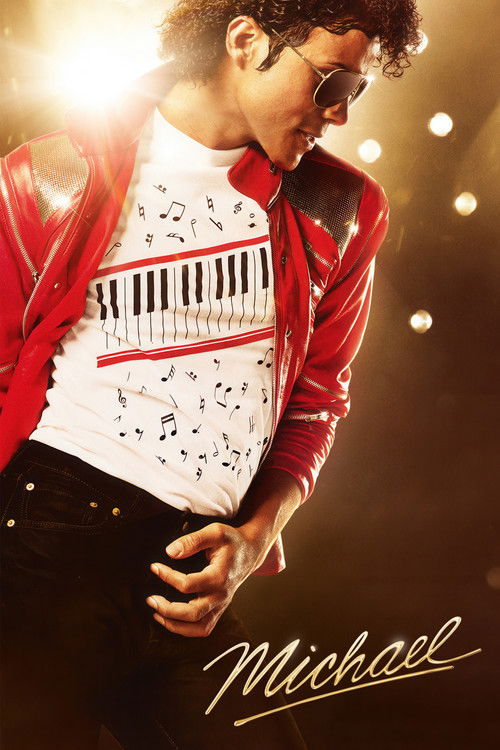
To a surprising extent, yes. Jaafar Jackson is the film’s clearest asset, and the performance is strong enough to keep Michael from collapsing under the weight of its own caution. What he gets right is not only the choreography or the outline of Michael’s physicality, though both are impressive. It is the softness, the precision, the vulnerability, and the strange kind of distance that made Jackson such a singular performer in the first place. He does not merely imitate. He inhabits the icon closely enough that, in the film’s best moments, you almost stop thinking about the mechanics of the performance.

That matters, because the screenplay rarely gives him a dramatic framework strong enough to match that work. Michael comes alive when it is dealing in music, movement, studio sessions, rehearsals, and stagecraft. It becomes much less confident when it has to dramatize contradiction, damage, or emotional complexity. The film understands performance better than psychology. It knows how to recreate an image, but not how to excavate a life. That leaves Jaafar Jackson doing much of the heavy lifting himself, trying to inject mystery and feeling into a film that too often settles for reconstruction.
Colman Domingo, as Joe Jackson, brings force and shape to the material whenever the film leans into the father-son dynamic. Those scenes have some actual dramatic current, because they are about pressure, control, fear, and the machinery of performance. But even there, Michael tends to simplify rather than deepen. It sketches trauma in broad strokes, then quickly returns to safer emotional territory. The result is a film that keeps brushing against something richer and more unsettling without ever fully committing to it.
Can a Michael Jackson biopic be credible when it is this cautious?
This is where the film starts to split open. Michael is a biopic made with obvious reverence for its subject, and that reverence becomes its greatest weakness. Instead of confronting the full weight of Michael Jackson’s public and private contradictions, the film narrows its focus into something much safer and far more manageable. It is not just selective. It is protective.

That would not automatically be fatal if the film replaced what it omits with some other kind of emotional truth. It does not. Rather than really exploring self-invention, alienation, collapse, and the cost of superstardom, it repeatedly smooths those ideas into digestible prestige-drama beats. It gives us fragments of pain, flashes of conflict, and hints of psychological fracture, but almost never lets those elements destabilize the narrative. The movie wants the aura of complexity without accepting the discomfort that real complexity would bring.
That is why Michael often feels less like a portrait than a monument: glossy, carefully sculpted, and fundamentally too protected to cut very deep. The most frustrating thing about the film is not that it is incompetent. It is that it is so visibly capable of being better. The craft is there. The scale is there. The central performance is there. What is missing is the nerve.
Fuqua directs with professional control, and there are moments when that control works in the film’s favor. The concert and rehearsal material has momentum. The sound design and musical presentation do what they need to do. The film knows that audiences have come to see a star reborn on screen, and in pure spectacle terms it often delivers. But it confuses sensory recognition with dramatic insight. Seeing a familiar pose, hearing a recreated vocal moment, or watching a carefully choreographed sequence land is not the same thing as learning anything meaningful about the person at the center of it.
Is the film more interested in the brand than the man?
Again and again, the answer feels like yes. Michael behaves like a film trapped between tribute and biography, and whenever those two instincts come into conflict, tribute wins. That might satisfy viewers who want the rush of the music, the visual iconography, and the broad emotional arc of a rise-to-greatness story. It is less satisfying for anyone hoping for a sharper, riskier film about what Michael Jackson represented, what he endured, and what he became.

This is especially limiting because Jackson remains one of the most culturally loaded figures modern pop culture has produced. He was not simply a superstar. He was a phenomenon built from genius, control, trauma, commerce, reinvention, obsession, and public projection. A serious film about him should feel unstable in some way. It should feel difficult. It should contain tension that cannot be resolved cleanly. Michael does not want that kind of instability. It wants order. It wants shape. It wants applause.
Can the box office still turn this into a win?
Very possibly. In fact, that may be the strangest thing about Michael. Artistically, it feels limited by how much it wants to protect its subject. Commercially, that same instinct may help it. This is still one of the most recognizable names in entertainment history, and the film knows exactly how to sell the scale of that legacy. The production budget reportedly sits around $155 million, with reshoots pushing that figure higher, so the financial stakes here are real. Early box office tracking has suggested an opening in roughly the $80 million to $90 million range domestically, which would make Michael one of the more significant music-biopic launches in recent memory if that momentum holds.
That makes Michael commercially understandable, but artistically frustrating. It is very good at reminding you why Michael Jackson became untouchably famous. It is much less interested in asking what that fame did to him, or what it cost. In the end, it functions more as an act of reputation management than revelation. That may be enough for the marketplace. It is not enough for a truly memorable biopic.
Is the show enough when the truth is missing?
Not really. Michael is not a disaster. It is too well-made, too slick, and too anchored by Jaafar Jackson for that. But it is also too cautious, too curated, and too emotionally controlled to become the great Michael Jackson film it clearly wants to be. The music hits. The imagery lands. The central performance has real power. But the drama surrounding it has been sanded down until it feels less like a life under pressure and more like a premium museum exhibit.
For some viewers, that will be enough. For a film about Michael Jackson, it should not be.
Data sources: FilmDB.co.uk and TMDb. Availability of information may vary, and accuracy is not guaranteed.
MusicDrama130 min