


There’s a very specific moment when a horror sequel gives itself away. It isn’t the first kill. It isn’t the first big reveal. It’s the moment the film starts explaining itself.
Ready or Not 2 does exactly that. And that is where the trouble begins.
The first Ready or Not worked because it was viciously simple. A bride. A rich, diseased family. One night. One rule: survive. It didn’t need much mythology. It didn’t need an expanded system. It didn’t need lore. It worked because it was lean, cruel, funny, and fast. The sequel seems to misunderstand that entirely. Instead of tightening the concept, it widens it. More rules. More backstory. More hierarchy. More world. On paper, that sounds like escalation. On screen, it mostly feels like dilution.

That doesn’t make Ready or Not 2 a bad film. It isn’t a disaster. It’s often watchable. Sometimes sharply entertaining. But it keeps reminding you how much better the first film understood its own engine. The sequel believes the audience wanted more universe. What they actually wanted was more pressure.
Ready or Not 2 Review — Can a Sequel Stay Sharp Once It Starts Building a Franchise?
That is the real question hanging over the film. The original’s evil felt absurd in exactly the right way. It was irrational, nasty, and barely held together by its own grotesque logic. That was the point. Ready or Not 2 begins filling in the dark corners. It introduces a larger structure, more rules, more explanation, and a mythology that seems designed less to intensify the horror than to stabilize it.

Once a film like this starts diagramming its own madness, it stops feeling dangerous. This is no longer a nightmare trapped inside one house. It’s a mechanism. A system. A scalable property. And horror almost never improves when it starts sounding scalable.
The film keeps trying to reassure you that the mythology is richer now, that the rules are deeper, that the stakes are larger. But “larger” is not the same thing as “stronger.” In this genre, it is often the opposite. Claustrophobia matters more than reach. Uncertainty matters more than structure. The sequel keeps choosing structure.
That choice drains the poison out of it.
Samara Weaving Still Understands the Assignment
The reason the film never fully collapses is Samara Weaving. She remains the one performer who still appears to understand why this universe worked in the first place.
Her character is no longer a terrified outsider stumbling through aristocratic insanity. Now she moves like someone who has already been through hell and is trying to calculate how much worse it can still get. That shift matters. There’s fatigue in the performance now. Suspicion. A harder edge. Weaving never overplays it. She doesn’t need to. The film becomes more alive whenever it stays close to her, and flatter whenever it wanders away.

There’s a darker, better version of this sequel hidden inside that performance. A version that would have focused less on expanding the mythology and more on what surviving the first film actually did to her. Not physically. Psychologically. Morally. What happens after you survive something that insane? What kind of person comes out the other side?
The film brushes against that idea. It never commits to it.
More Characters, Less Weight
The new emotional architecture — especially the sister storyline and the broader web of added characters — is where the sequel starts to feel genuinely underwritten. On paper, it makes sense. A sequel needs fresh emotional stakes, not just recycled mechanics. But the film doesn’t give these relationships enough depth to make them land the way they should.
That’s frustrating, because this is exactly where the film could have found something new. Not more mythology. Not a larger supernatural architecture. Just sharper human damage.

Instead, too many of the new characters feel functional. They move the plot. They explain the next step. They give the sequel more bodies and more noise. What they rarely do is complicate the film emotionally in a lasting way.
The first movie’s family felt grotesquely memorable. This new ensemble is merely busy.
More Blood, Less Bite
The sequel certainly isn’t shy about violence. If anything, it becomes more excessive. But more gore doesn’t automatically mean more impact. In the first film, the brutality worked because it arrived with timing, malice, and comic precision. Here the bloodshed is more abundant, but less surprising.

The same goes for the humor. There are still moments where the film hits that sweet spot between absurdity and cruelty. They just come less often. That’s the difference. The first film felt wicked. This one often feels dutiful. The violence is there. The jokes are there. The machinery is there. The sting is not.
The Film It Could Have Been
There is a much better Ready or Not 2 buried inside this one.
A smaller one. A meaner one. A sequel less interested in franchise expansion and more interested in what survival costs. A film that doesn’t explain the system, but tightens it. A film that doesn’t widen the mythology, but corrodes the protagonist. A sequel that asks not “how can we make this bigger?” but “how can we make this worse?”
That would have been the truly ruthless follow-up. Not the louder film. The closer one.
Instead, Ready or Not 2 behaves like a movie already thinking about the third installment. That instinct is visible in almost every major decision it makes. The result is a sequel that is professionally assembled, occasionally fun, but far less vicious than it needed to be.
Final Verdict
Ready or Not 2 is not a failure. It isn’t embarrassing. It isn’t cynical in the most obvious way. Technically, it works often enough. Samara Weaving still carries the right energy. There are set pieces that land. There are jokes that hit. There is blood everywhere.
But this sequel makes a classic mistake: it confuses expansion with escalation. The first film didn’t work because it hinted at a larger world. It worked because it was fast, nasty, and simple. The second film keeps trying to look smarter than that. And in doing so, it becomes less dangerous.
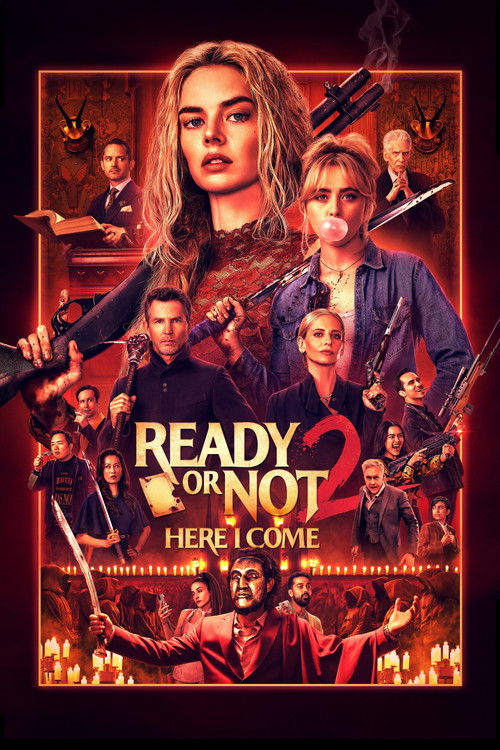
Data sources: FilmDB.co.uk and TMDb. Availability of information may vary, and accuracy is not guaranteed.
HorrorComedy108 min