


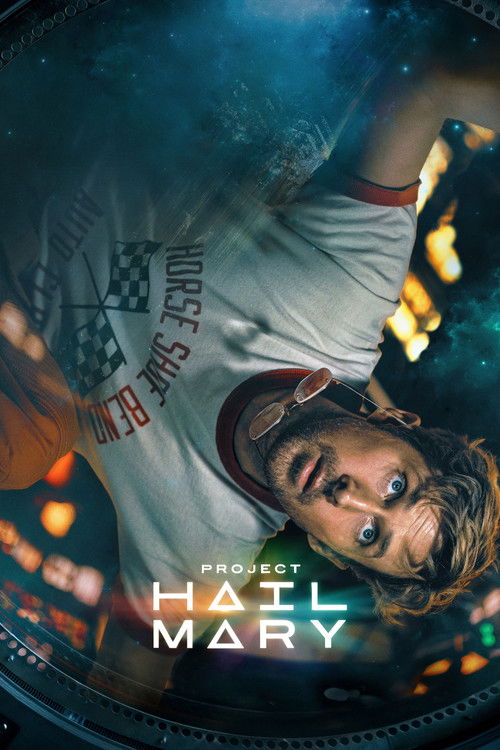
Ryland Grace (Ryan Gosling) wakes up in a sterile white room. He doesn’t know who he is, where he is, or why he’s there. All he knows is that something important needs to be done — and it’s urgent. The film uses this slowly recovering amnesia as its launching pad, and Lord and Miller handle it smartly: the flashbacks don’t break the rhythm, they expand the picture piece by piece. By the time Grace realizes he’s alone millions of miles from Earth, surrounded by two dead crewmates, with the fate of all humanity resting on his shoulders — the audience is already so deep inside his head that the absurdity of the situation barely registers.

Gosling isn’t playing the dangerously charming version of himself from The Nice Guys, nor the ironically self-aware version from Barbie. Grace is a tired, desperate scientist who accidentally became a hero — someone who had given up on himself back on Earth and is now forced to believe in himself again. Gosling carries this internal contradiction, this reluctant, hesitant, slowly unfolding courage, with complete authenticity. His gift for physical comedy is also on full display — the film leans into it liberally — but never at the cost of reminding us that this is fundamentally a mediocre middle school science teacher running the universe’s most consequential solo mission.
Rocky — The Heart of the Film
The question that had been tormenting fans for months before release: what is Rocky going to look like? The answer: puppetry, animatronics, and the voice of Lionel Boyce — minimal CGI, maximum presence. Rocky feels real. Not real the way a well-rendered pixel character does, but physically there in the frame, and that changes everything.

Rocky’s animation is a genuine achievement: the expressive movement of the faceless creature’s limbs conveys a surprisingly wide emotional range even without the makeshift translation device Grace cobbles together, and the film only rarely falls back on slapstick comedy derived from the language gap between the two species — more often, the careful explanation of abstract concepts becomes the most moving thing on screen, as two intelligent beings learn to share the more philosophical dimensions of existence. Könyves magazin
The Gosling–Rocky pairing has already, after just the first screenings, been placed alongside R2-D2 and C-3PO in the pantheon of great on-screen duos. There are scenes where you just sit there with a quiet half-smile, watching something that is simultaneously profound and completely ridiculous. That rare magic is Lord and Miller’s greatest strength — and here, they deploy it perfectly.
The Look and Sound of Deep Space
Greig Fraser’s cinematography (Dune, The Batman) is simultaneously luminous and atmospheric — space has rarely looked this beautiful and this terrifying at the same time. A significant portion of the film was shot in IMAX 1.43:1 aspect ratio, and you feel it in the cinema: the first discovery of the Tau Ceti system, the arrival of Rocky’s ship, the visualization of the astrophage swarms — these are images worth seeing on the biggest screen available.

Daniel Pemberton’s score — who previously collaborated with Lord and Miller on both Spider-Man: Into the Spider-Verse films Wide Screen — does exactly what a score like this should: it amplifies emotional moments without overwriting them, and invents its own musical language for the evolving Grace–Rocky communication that is subtle, inventive, and quietly unforgettable.
Drew Goddard and the Question of Faithfulness
Drew Goddard is adapting Andy Weir for the second time — he wrote The Martian in 2015, and now takes on Hail Mary. The screenplay is remarkably faithful to the source material and strikes a careful balance between science, humor, and heart. PCGURU That is no small feat, given how much of the novel consists of internal problem-solving that is genuinely difficult to visualize.

That said, dedicated fans of the book should brace themselves for certain losses. The most electrifying quality of Weir’s original was that the problem-solving was the action — Grace spends pages calculating the astrophage’s energy balance, and the reader is right there with him, understanding it, rooting for it. Little of that survives the adaptation. Lord and Miller accelerate the pace, science takes a back seat to spectacle, and Gosling’s Grace becomes a confident, charming action-adjacent hero faster than he ever does on the page. That anxious, tormented scientist — the one who fundamentally doubts himself — is more of a thin surface layer in the film than a core character.
Watch the Project Hail Mary ‘Grace Meets Rocky’ Clip
The flashback sequences showing Grace’s life on Earth are also a mixed bag: compared to the momentum of the Grace–Rocky interactions, these episodes sometimes slow the film down without adding sufficient dramatic weight. Könyves magazin
Sandra Hüller and the Earth Thread
One of the film’s more pleasant surprises is Sandra Hüller as Eva Stratt — the cold, almost omnipotent European bureaucrat who orchestrates the entire Hail Mary mission. Fresh off Anatomy of a Fall, Hüller plays a radically different kind of character here: lean, emotionless, borderline ruthless in showing us the kind of person capable of sacrificing anyone and anything for the sake of saving humanity. The Earth-set storyline could easily sustain its own film — but here it necessarily takes second place to the Grace story, which is the film’s only real structural frustration in its middle act.
Where It Stumbles
As the runtime winds down, the film seems almost afraid to end. The final fifteen minutes stack leavening moment upon leavening moment — each one would be deeply moving in isolation — but together they wear each other down. There is a single, overwhelming, heart-stopping beat near the end that deserves to be the film’s last note. It isn’t, and that’s a mistake you carry out of the cinema with you.

There are also stretches in the middle third where the film loses momentum. Lord and Miller fall back on humor and emotional resonance where exponentially escalating scientific stakes might have served better — and that trade-off doesn’t always pay off across 156 minutes.
Is It Worth Seeing in Cinemas?
Project Hail Mary is exactly the film it could have been with this studio and this directorial pairing: spectacular, emotionally resonant, frequently brilliant blockbuster entertainment that doesn’t bring the book’s scientific depth to the screen, but does bring its soul — the power of connection across incomprehensible difference, the fundamentally optimistic belief that intelligence, in whatever form it appears in the universe, will find a way to collaborate.

With this film, Lord and Miller prove that they belong among the very best in live-action studio filmmaking as well. Gosling delivers one of the best performances of his career. Rocky is the most lovable new film character of the decade. If somewhere between Interstellar and The Martian, a cheerful alien made of rocks gets lost in space — this is that film.
Essential cinema. On IMAX if at all possible.
Data sources: FilmDB.co.uk and TMDb. Availability of information may vary, and accuracy is not guaranteed.
Science FictionAdventure157 min