

Julianne Moore has always been an actress dedicated to her craft. From her character leaning roles in Todd Haynes’s masterpiece Safe and PTA’s Magnolia to her Oscar winning performance in Still Alice as an Alzheimer’s victim, to even comedy and blockbuster titles with the Hunger Games and Crazy, Stupid, Love. It is clear that Julianne does acting for the love of the game and can dabble in all kinds of stories to bring fresh, provocative characters to life with an interesting story to tell. For the 79th Cannes Film Festival, Julianne is attending as a guest of honour for Kering’s Women In Motion talks to dive into her career and spotlight her experience on set as a female creative, noticing the changes of the industry for women since she first entered Hollywood. Since 2015, Kering’s program has celebrated women in cinema, both in front of and behind the camera. For this year’s edition, the Women In Motion honouree was awarded to Julianne Moore. An Oscar winning, Emmy Award winning, and the European Triple Crown of acting winning performer that has had a decorated career and continues to be a beacon of inspiration for women worldwide.
S] With all of these prizes in mind, what does it mean to be saluted for your career that reflects the values of Women In Motion, where you have chosen roles that have uplifted women and created a nuanced, exciting portrayal of your gender in cinema.
Julianne Moore: I like our gender. I’m very proud to be a part of it. It’s such a tremendous honour and a thrill to be here and to be celebrated in this way. It’s definitely surprising. I always say that as an actor, you’re part of a gig economy. You’re always going from one job to the next job. So, you’re thinking about what’s next always and not what’s behind you. When you realize that you’re being celebrated or asked to speak about what’s behind you, you turn around, you go wow, this is something that I’ve created or I’ve accumulated in my life. It’s quite a nice point of reflection and it’s a wonderful honour.
S] Was there anything that stood out when you reflected on your career?
Julianne:I was just talking to somebody about memory the other day. I did an interview with Don Cheadle, and we’ve been friends for 38 years. So we were recollecting all of this stuff from our shared experience. There were things where I had big holes. He would remember things that I’d completely forgotten and vice versa. So, I don’t know when I think about my experience, what I remember honestly, is the pleasure, that kept moving me forward, this idea that I really loved what I did, I love what I do. I always want to be in the doing of it. I’d rather be in the doing of it than even the talking about it, because you almost go into a fugue state. I think when you’re working where you’re not quite sure what you’re accessing. I like that feeling. I love the feeling of embodying people and telling these stories and feeling those feelings. I think that’s what we want out of art. We want that feeling of emotion. Always.
S] When did you first have that feeling? Was it when you were just in school, learning to be an actor? What was the first time you got that feeling on a set?
Julianne: It was really when I started to read, when I learned to read, and it felt like it was such a point of a feeling scene and association that I got when I was in a book and I felt that wow, it was sort of miraculous to feel seen in that way. To know that other people felt the same way, to the point that I really thought it was such an intimate thing to be writing a book. How can people be exposing this about themselves? How do they know this about me? Then you realise it’s really about the universality of human experience. When I found that I could take that feeling of reading a book and do it after school in the theatre club, which is where, as a kid who was not sporty, I wasn’t athletic. I wasn’t even good enough for the drill team or anything like that. You end up doing these plays, and it really was an extension of reading that brought me to it.
S] You do these plays. You’ve become a professional actor. You come to Cannes for the first time. A very famous play that you’ve translated to film. What is it like to then, transform and translate that feeling, to what you bring to the screen.
Julianne: It’s great. It’s even better because as everybody knows, who works in film, it’s a highly collaborative event. The experience of going from reading something, being in your head with something and feeling seen by an author or by a book but taking that and going to a physical place where there are other people who are collaborating with you, other actors, other storytellers, a director, a production designer, a costume designer, it’s literally an elaborate game of pretend. So everything that you do as a child that you absolutely adore, suddenly you’re doing professionally with a bunch of other people who love to pretend, but you’re telling a story of what it means to be a human being, what it means to be alive. They could be really funny. It could be deeply sad. Whatever it is, it’s deeply human. I found a way to take my childhood pastime, which was reading, and drag it into my adult life with other people who like to collaborate in that same way. So there really is nothing better. The thing about film is that you actually end up with an object, with this document that can last forever. Which is unbelievable, really.
S] Nicole Kidman was the recipient of this award last year who consistently champions women led stories, and you have now taken on the mantle. What has it been like to carry her banner forward in the commitment to women in motion.
Julianne: Well thank you. First of all, that’s very nice. I don’t know that I’m doing that but I think that she definitely set an example that I like to try to follow. But I think that what has been most interesting to me and what has developed more strongly as I’ve gotten older and been I feel like more in charge of my choices because initially when you start out, you just do what comes your way. You don’t really have a lot of choices. You think great, I have a job, I’ll do it. And then slowly you gain a little more authority and you are stressing, this is what I want to do. And one of the things that I talk about endlessly, in a way that’s probably boring to a lot of my friends as point of view. You know, what I’m looking for in a story is where is the point of view. I want it to be obvious, and I want my character’s point of view to be represented. And I’m also fine being in a story where it is not from my character’s point of view. I know where I am, but I know how I’m relating to the main character or the director is kind of omniscient. I’m fine with that, but I want to be clear about whose story it is, how it’s being told, and whether or not it’s accurate. I often find that there are places that people will skip that step. But why does this character do that? And they’ll say because she wants to, she’s the bad guy. But why is she the bad guy? Because we need a villain in the film? But nobody’s a villain and nobody’s the bad guy, and everybody’s always acting out of what they believe is true and right. We saw a film last night, Gentle Monster, and it’s something that really sat with me by a wonderful female filmmaker and wonderful actress in Lea Seydoux. It was so firmly set in a female point of view and what it means to live in society where you are not the dominant culture, where you’re being affected by things that you don’t recognise. It was told so subtly, beautifully and so movingly, and it was so very female. It was really exciting to watch because it wasn’t didactic, there was nothing harsh about it. There was just a realisation that these women were living in a world where they had been really affected by the patriarchy and by male decisions. A beautiful thing to see and Cannes is where it is really the ultimate place to watch films, where you are so focused, where you can see everything and have no distractions.
S] You don’t have to be the protagonist.
Julianne: No. To have your point of view actually represented in a story more often than not. I mean, that is the feeling. Sometimes it says, you are the wife or the girlfriend. But you also want to have an actual rounded story, that depth of understanding. It’s also okay to be somebody who’s defining of the main character. I don’t mind that either, so that I understand that I’m in relationship to that. But I want clarity around it. I’m interested in stories where I feel like things are authentically represented. We were talking about names this morning and how you can tell when someone was born by what they’re named and how some names go in and out of fashion. What is a name that your grandmother and your mother might have had, or that specificity in a screenplay, somebody knowing where somebody exists in time, what they relate to, what their name would be, all of that stuff really contributes to knowing who that character is.
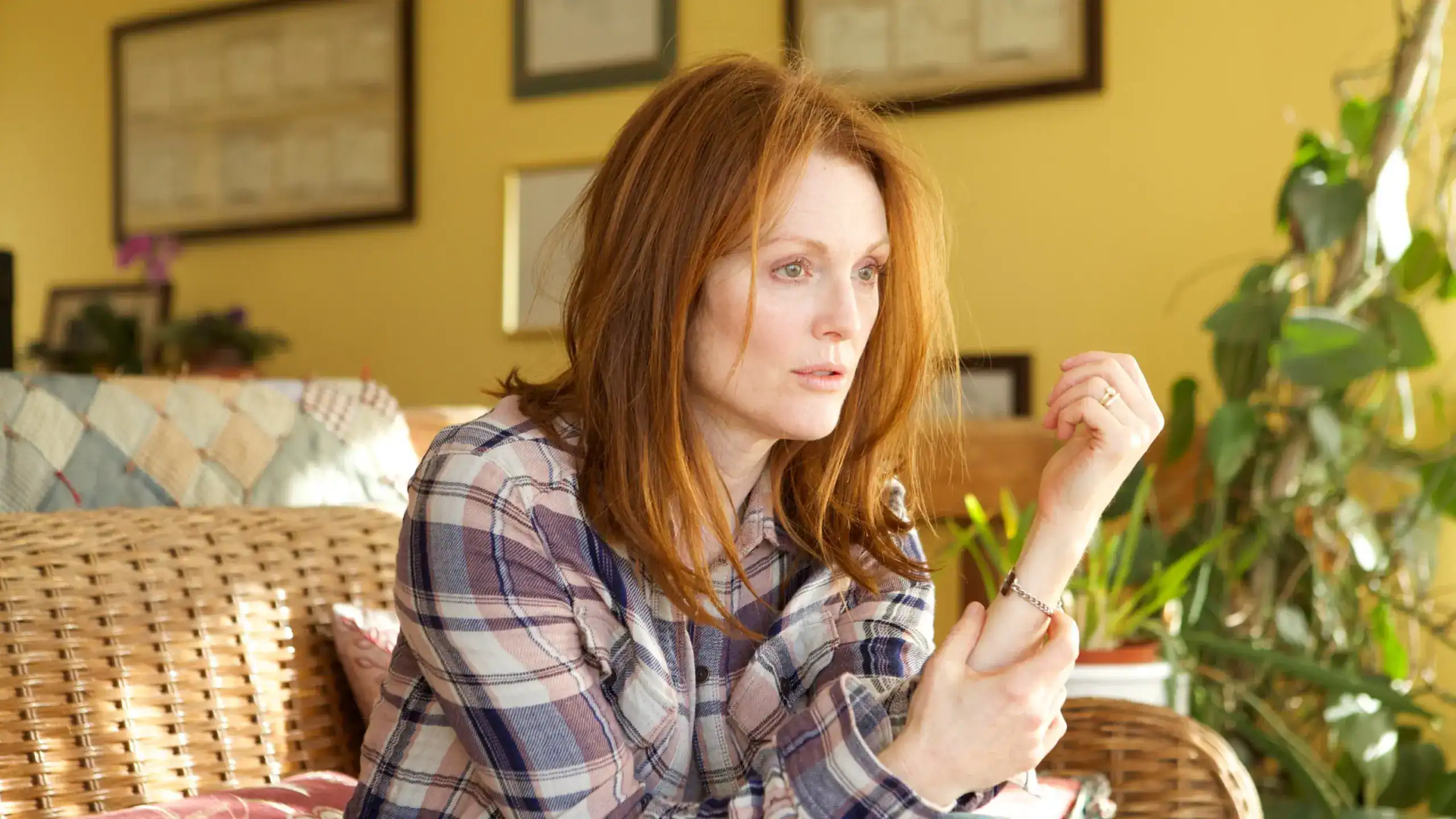
Julianne Moore in Still Alice, courtesy of Sony Pictures
S] Now that you have options, what has stood out to you in the roles that you’ve taken recently?
Julianne: What’s interesting to me is I’m less interested in tragedy. I think that particularly now, at a time when things are really rough globally, it’s very difficult for me to invest in a story that I think is pretend where I feel the depth of the emotion, the measure of it doesn’t measure up to what’s happening in the world. I don’t feel like I want to engage in it. There are times when I see things emotionally, when something is there for stakes. I don’t like easy stakes. I don’t like someone being murdered. I don’t like explosions and guns. I don’t like histrionics. I don’t like things that raise the stakes without real feeling underneath. It actually bothers me. That’s just noise. I don’t know how to play it. I don’t know why. I don’t want to watch it. That’s been interesting because things that I might have thought were interesting years ago because I hadn’t attempted to do them, are less interesting to me now.
S] You’re making a new movie with Jesse Eisenberg which is a comedy musical. What was it about that role for you?
Julianne: God, what wasn’t it? I think I can probably count on two hands the scripts that I’ve read in my career that have made me electrified. This was one of them. Jesse Eisenberg and I had worked together on his first movie called When You Finished Saving the World, and he’s a really assured, wonderful filmmaker. He sent me this screenplay and said I wrote something and I really hope you’ll do it. It was magnificent. It’s a comedy and there’s definitely an elevated tone to it. But when you talk about things that matter and it’s really a story about a person who finds the world that she wants to commit to, and finds a place where she feels valued, a community that she can belong to. And it happens to be community theatre. But that’s what matters to people. This is a person who auditions for community theatre, and it matters to her whether or not she gets this part and the world. So, those are the emotional stakes I understand. Caring about your best friend’s birthday party and does everybody come? Have they RSVP’d and is she going to like what I got her. Those human stakes, I’m very interested in those and this film has it in leaps and bounds, and it’s joyful. It’s about the human experience. The expression of feeling. It’s funny and extreme, but it’s imaginative in a way that I find really refreshing.
S] How does the experience of getting that script fit into that evolution of having more choices and what you desire from the experience?
Julianne: That’s interesting. I wish I believed that. Sometimes I do but I feel like there’s a period of saying no that I think is too dark or no or there might be a time of reframing. I’ve never found that anything in my career has been linear at all. It’s been so up and down, You’re thinking I’m never going to find anything interesting until suddenly you think, I really find that interesting. You just don’t know. So much of what we do relies on creators and writers, to come our way with stuff. I do think that you develop an ear for what you like and it takes a lot of work. It takes a lot of reading and digging and watching and looking, and then you start to be able to say that’s what I would like to do.
S] How far into a script does it usually take to know if it’s a yes or no?
Julianne: If it’s a yes, it’s usually immediate. If it’s a maybe or a no, I’ll go all the way to the end. That’s the worst when it’s a no. I read the whole thing because I keep hoping it’s going to get better. You’re thinking there’s going to be something. You got to kiss a lot of frogs.
S] As you focus on finding those stories that speak to you and finding ones with a strong point of view. Women are still statistically struggling in terms of representation on screen and behind the camera. Women make up 52% of the population but women’s roles fell from 41.3% in 2024 to 37.1% in 2025.
Julianne: This is a discussion that I’ve been having about our work, women’s representation from the very beginning of my career and I always say it’s not endemic just to the film industry, it’s global. There’s no representation in the C-suite. There’s no representation in media, there’s no representation in higher education. So there are lots of places where we don’t have the representation that we deserve. It’s a bigger problem. How do you change that? I don’t know. How does a mouse get through a wall? One bite at a time. You do it slowly, steadily, mindfully. Making choices, speaking up, using your privilege, hiring more. Talking about alliances, changing things for us on set. I feel like women are each other’s greatest allies. That’s the secret sauce. We are the ones that have each other’s backs. We are the ones that hire each other. We are the ones that write stories about ourselves. That actually goes back to point of view too. Who’s telling that story? Whose point of view is it? Is it a female point of view? That’s what you hope for.
S] What does that change look like for you in terms of the choices that you make? Most of your team is made up of women for example.
Julianne: Yeah my entire team with the exception of my publicity team are female. I think it has to do with who’s drawn to whom. Why are we together? We have the same tastes. We have the same interests. We gravitate to the same material. That’s been something that sort of happened, magically. You do it because your values and your interests align.
S] When you look at the innovations throughout your career. In terms of representation, seeing where people on set, what have you seen over time?
Julianne: I’ve seen the incremental change. I have definitely seen change. I can remember being on a set not too long ago where the only women on set were me and the third AC, this young woman. It was when Hillary Clinton lost the election and we were both devastated. I said, look around the room. It’s just you and me. We’re the only ones here. It was shocking to her, too. I think she was 24 or something. So I’ve certainly seen more gender representation in crews now. That was really unusual when I was coming up to see any women on a film set on a crew. So that has changed. There have been more female directors, more female writers. In terms of actresses, they’re my girls. They’re always there. We’re always together. I can remember back in the day, when I auditioned for something, I would call my agent or manager afterwards and say are we going to get it? And as I feel like she’s going to, I said, how do you know? Because I sit next to her every time. We’re always there. I know it’s going to be her. I know you know the other women’s strengths. Well she’s going to be the better choice. She’s going to be the one that…so there’s more. There’s an incredible alliance among actresses and a sense of admiration for one another’s work and strength. Not a competition either. That’s the thing. You sit next to someone for decades doing well, and you haven’t auditioned in a while. But you sit next to someone all of those days. It is not that you are bothered necessarily that she got the role. It’s that you know people’s strengths. You know when someone will serve the material better than you. You also know if you have a really strong feeling about something that you might serve the material better. I understand that everybody has their vibe and it gives you opportunity to know when to work with them in the future. What would be a great opportunity to collaborate with someone.
S] What advice do you give your daughter about navigating representation? Because obviously you have done it in a in a different industry. But figuring out how to still accomplish the things that you want to accomplish, knowing that we are less represented.
Julianne: I give my children the same advice, my son and my daughter, just in terms of the world that I really encourage. I said work ethic is more important than anything else for a young person. Whenever you see a young person with a great work ethic, an older person will be like, come with me, I have a job for you. Then just do it. Get it done, be prepared. I talk a lot about confidence. This idea that confidence is innate is sort of crazy. It’s not. Confidence is something that you have when you have prepared yourself. So be prepared. Be educated. Know what you’re supposed to do. Then you’ll be confident walking into it. I think that both of my children feel they’ve lived in a patriarchal world in our family. So I think it’s the way they see the world. I think they’ve been cultured in a way that hopefully will help them bring equality, gender equality forward.
S] How do you look at the journey that you went on, the trajectory that you had, how you found your way to succeed?
Julianne: I still can’t believe I can make a living doing this. I cannot believe it. I have so much gratitude. I just don’t know. I say to my children too, I think it’s so important in life to follow your interests that being interested in something brings you everywhere. Being interested in people, being interested in material, being interested in the world and in travel and in conversation and all of those things. If you do the things that you like doing and do them well, it leads you somewhere. It goes back to that thing about going into the theatre club and thinking, this is so much fun, I love this, I love doing it. I think that that the pleasure and the joy for me helped me withstand the times when I’m like, this is a drag. All of these auditions and the tough stuff, I think that…I can’t wait to go to work. I’m always so excited to be there. It’s such a privilege. To find something that you care about and to do those little pieces, to think of it that way. Never think of it like if I thought that I had to go from college to here. I’m like, how do you get to Cannes? I’m never going to get to Cannes. It didn’t seem possible. But I think little steps. It doesn’t end either. It doesn’t end. There is no end. People are always asking each other because we want to be, it’s assured by the fact that there’s some narrative to life that there’s a beginning, and you go like this, and then you’re going to wrap it up at some point. It’s just not that way. Life is where you keep going and going, and then one day it’ll end. We don’t know when. We hope it’s not anytime soon for us or our loved ones or anybody, frankly. You keep doing and keep being interested and keep connecting with people, and keep finding things to do. I love to see the continued journey, the continued trajectory, and also the way so many things come full circle.
S] You signed on as an executive producer last year’s Oscar winning short film, Two People Exchanging Saliva. What was it about that film that made you want to support?
Julianne: I wanted to be an ally. It was a short that I saw. They are really accomplished filmmakers. It’s a very imaginative, arrestingly short film with wonderful performances. I just met them for a coffee and talked about it and then said how much I like their work. And they were looking for people to guide them. I think Isabelle Huppert’s involved as well, I’m a major fan, she’s a friend of mine. I love her. So we were just there to be allies. It was such a great experience just to be able to talk to them, do a little bit of press to support it, get it out there just to just to make people pay attention to it. I loved the experience of it. I just did it out of pleasure, out of interest, because I wanted to support them. We’re living in an attention economy now where everybody’s like, lights are flashing and things are going off and people are like, look over here, look over there. If you have the ability to help something find a place in the culture to draw attention to it, it’s very nice to be able to do that too.
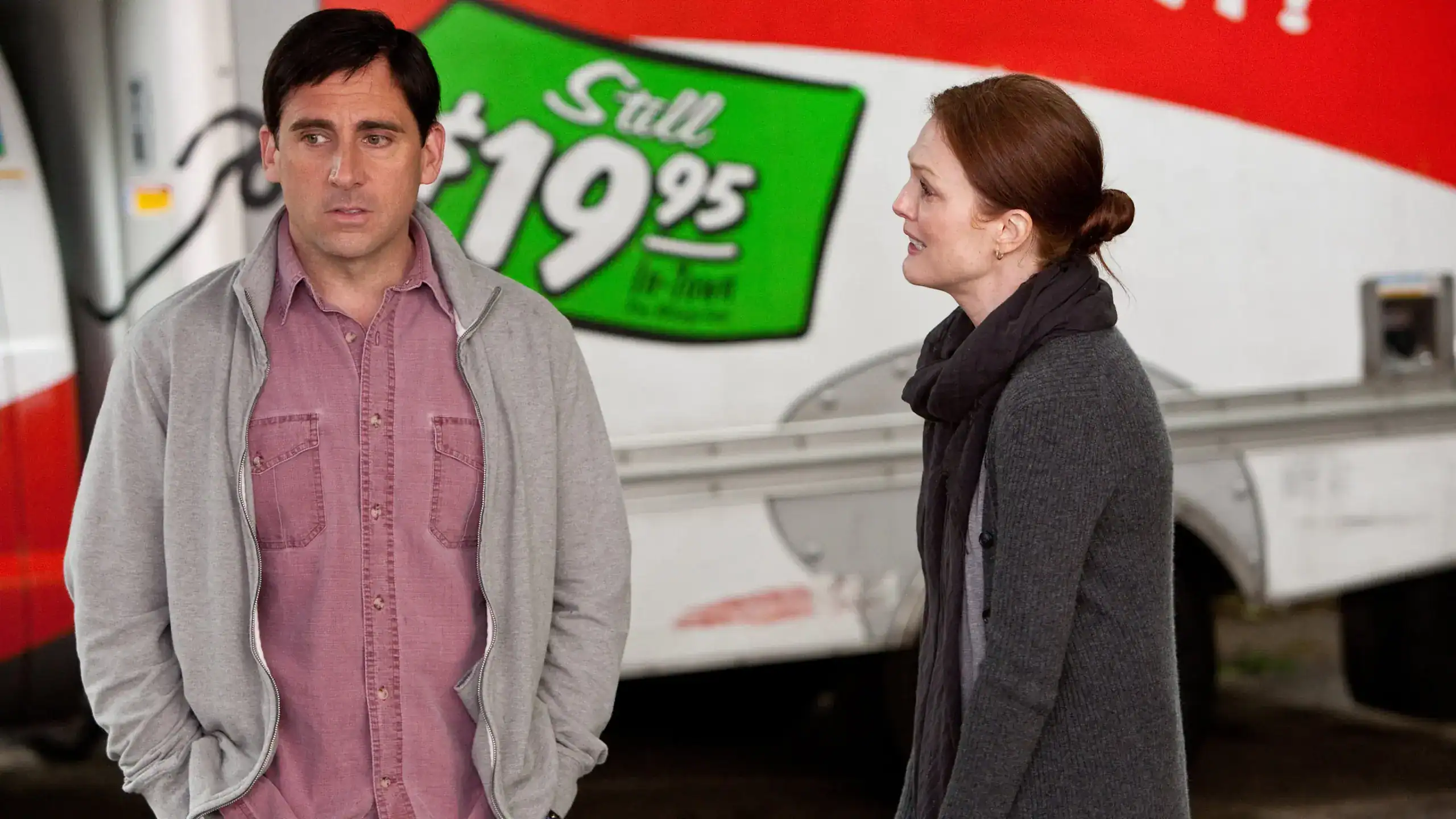
Crazy, Stupid, Love. courtesy of Warner Bros
S] It is actually going to be the 15th anniversary of one film. Crazy, Stupid, Love. Now you’re having a pseudo reunion in a way with Emma Stone who is producing that film that you worked on with Jesse Eisenberg.What is it like to see how far she has come?
Julianne: She’s just an incredible talent and from the minute that I met her, she’s so lovely and wonderful, and gifted and alive on screen. She was in Crazy, Stupid, Love. and now she and her husband Dave have started this production company, Fruit Tree, they produced Jesse’s first movie and then this one as well. I think they’re doing great work and they have wonderful taste and it’s marvellous to have a creative relationship with someone I’ve known for so long.
S] Your role in that film does speak to having a point of view for all of the characters. It’s a great ensemble comedy.
Julianne: There was this one line of Crazy, Stupid, Love. that I loved so much. I told Dan Fogelman because it was so specific and it was about her marriage breaking up. She says to him that time that I told you I was working late, I went to see Twilight and it was so good. And she starts to cry. But what Dan manages to say in that line is, I’m so unhappy in my marriage that I went to see a romantic film, but then I realised it’s a film about vampires and teenagers, and it’s not for me. What I’m really missing is my own marriage. But he does it in that one line, and it’s funny. When you think about something that resonates with people emotionally because it is moving and it’s human, but it’s specific. It’s really specific about relationships, and what people want. Even when people talk about something funny, I’m like, well, what does it mean? Why is it what? Why is it resonant? Why do you remember it forever? Because it’s really saying something so much deeper about the human experience.
S] How was winning the Oscar for Still Alice. What do you remember?
Julianne: I remember. I remember somebody saying to me, and I wish I could remember who it was. Well, you’re going to win the Oscar tonight, or else it is going to be the biggest upset of all time. I thought I don’t want to be the biggest upset of all time. I don’t know who it was. Eddie Murphy also came over. That was pretty awesome. We were in the front row. He just came over and introduced himself, and my husband almost died because he’s a huge Eddie Murphy fan. I couldn’t believe it that it happened. I feel so lucky and the upset. Well, because I had won everything. So he was like this, he was basically saying that you’re going to win tonight, but if you lose, it will be the biggest upset. So if you win it was sort of like betting on a horse. These are the odds and they’ve been that way the whole season. So if I lost my gosh you put money on it or whatever. No I’m glad you clarified because it is a shocking thing for someone to do. I wish I could remember who said that. But it’s probably because I was like oh no. I remember I was last to it, you don’t know what the order is going to be. And I was sitting there and then I was like, oh, I’m last. You have to sit through the whole ceremony with the anxiety.